


In some respects, we’re again to the place we have been in 2021 when the availability constraints that arose from the COVID lockdowns and widespread diseases began to disclose themselves in escalating costs world wide. This time it’s the US-Israel folly within the Center East that’s the wrongdoer and the availability constraints are largely confined to vitality, particularly oil (and its spinoff merchandise). And just like the COVID inflation, the present inflationary pressures will show to be transitory and can dissipate as quickly as Trump will get bored and decrees his folly is over. It’s irresponsible to regulate financial coverage, which may have long-term penalties, to cope with a short-term blip, particularly when the causes of that blip usually are not delicate to rate of interest modifications. When the RBA hiked rates of interest once more they knew they might not justify it primarily based on the vitality price rises. Everybody is aware of these price rises are non permanent. So the RBA resorted to “capability constraints” and ‘rising expectations’ to justify their motion but offered no sturdy proof to assist these assertions. It was ideology triumphing over cause. Simply what we have now come to count on from our central financial institution.
On Tuesday (Could 5, 2026), the Reserve Financial institution of Australia (RBA) elevated rates of interest once more – the third time this 12 months.
Within the media launch accompanying the choice – Assertion by the Financial Coverage Board: Financial Coverage Resolution – the RBA sought to justify the rise with an extra demand narrative – “capability pressures” and claimed that the rising rates of interest will imply that:
… demand progress slows and capability pressures ease …
The RBA additionally rehearsed the mainstream ‘inflationary expectations’ argument that claims that rising inflation turns into in-built to the choice making of companies and households, which then turns into a self-fulfilling dynamic unbiased of the unique causes of the rising costs.
The story then goes {that a} sharp downturn in demand is required to expel these expectations from the system.
That is Milton Friedman model XXX.
It’s a pity that this nonsense nonetheless has foreign money in central banking and is used as a smokescreen for his or her irresponsible determination making.
In 2021, the Board of Governors on the Federal Reserve Board, Washington, D.C. revealed a analysis paper – Why Do We Assume That Inflation Expectations Matter for Inflation? (And Ought to We?) – (a part of the Finance and Economics Dialogue Sequence 2021-062), which was written by a senior advisor to the Financial institution, one Jeremy B. Rudd.
Jeremy Rudd is an economist on the Board of Governors of the Federal Reserve System within the US, and, beforehand held senior positions with the US Treasury Division and served on the Council of Financial Advisors for a number of years.
His paper presents a frontal assault of the mainstream concept that inflation turns into self-fulfilling by way of rising inflationary expectations.
The opening paragraphs inform us of the intent:
Mainstream economics is replete with concepts that “everybody is aware of” to be true, however which might be really arrant nonsense …
None of those propositions has any form of empirical basis; furthermore, each seems to be critically poor on theoretical grounds … Nonetheless, economists proceed to depend on these and related concepts to arrange their desirous about real-world financial phenomena.
That may be a good begin.
He then launches into the present central financial institution orthodoxy that was as soon as once more rehearsed by the RBA governor on Tuesday when she was attempting to justify the unjustifiable – mountain climbing rates of interest to go off a supply-side phenomenon, the place the important thing drivers are in no way delicate to Australian home rate of interest variations:
I study one such thought, particularly, that anticipated inflation is a key determinant of precise inflation. Many economists view expectations as central to the inflation course of; equally, many central banks think about “anchoring” or “managing” the general public’s inflation expectations to be an necessary coverage purpose or instrument. Right here, I argue that utilizing inflation expectations to clarify noticed inflation dynamics is pointless and unsound: pointless as a result of another rationalization exists that’s equally if no more believable, and unsound as a result of invoking an expectations channel has no compelling theoretical or empirical foundation and will doubtlessly lead to critical coverage errors.
He invokes a traditional quote from the 1946 traditional by J.R. Hicks – Worth and Capital (revealed by Oxford College Press):
Pure economics has a outstanding manner of pulling rabbits out of a hat — apparently a priori propositions which apparently consult with actuality. It’s fascinating to attempt to uncover how the rabbits received in; for these of us who don’t consider in magic should be satisfied that they received in in some way.
The dominant mainstream macroeconomic theoretical framework – New Keynesian economics – locations the concept the hyperlink between the true financial system (exercise – output, employment and many others) and inflation is intrinsically linked by way of value expectations fashioned by decision-making ‘brokers’ (as people are referred to as within the fashions).
The theoretical assist for this method is weak, to say the least and I received’t rehearse them right here.
I’ve many weblog posts from the previous the place I focus on the constraints, for instance – Mainstream macroeconomic fads – only a waste of time (September 18, 2009).
Curiously, one of many early architects of what has turn out to be New Keynesian macroeconomics – Leonard Rapping – completely rejected his earlier work and accused governments of following the concepts in his earlier work of facilitating “transfers cash from the poor to the wealthy” (Supply).
He was a College of Chicago graduate (Milton Friedman’s affect) and his early work was with Robert Lucas Jnr, who was given the Nobel Prize in 1995 “for having developed and utilized the speculation of rational expectations, and thereby having remodeled macroeconomic evaluation and deepened our understanding of financial coverage.”
RATEX as it’s recognized posits that everybody understands the true underlying financial mannequin and that on common we have now excellent foresight because of this (our forecasting errors have a zero imply).
The truth that such nonsense is definitely a core a part of the mainstream principle needs to be ample for any critical minded particular person to reject such economics outright.
Leonard Rapping was interviewed for Arjo Klamer’s guide “The New Classical Macroeconomics” Wheatsheaf Books, 1984.
On methodology, Rapping says of his Chicago days:
… we have been within the Chicago custom, so we assumed excellent competitors and revenue and utility maximisation. Each single proposition needed to be per these assumptions. There have been sure guidelines of logic that needed to be adopted, and the discussions have been very tight and logical. We might attempt to clarify the whole lot by way of the aggressive equilibrium fashions. (We had discovered that from Friedman) …
Someday later, Rapping grew to become extraordinarily disillusioned with the Vietnam Conflict and noticed that the logic of the battle clashed with the coaching he had obtained at Chicago, and was, in flip, passing on to college students himself. He mentioned:
I found that the battle was improper: I got here to the conclusion that it was an illegitimate battle and America was an imperial energy. That disillusioned me. In all my coaching at Chicago there was no critical point out of the worldwide system. Chicago coaching, like coaching elsewhere, was closed financial system coaching. I knew that the Chicago world imaginative and prescient was inappropriate for the issues I used to be involved with … You can’t have democracy at residence and an empire overseas … Friedman by no means talked about something about overseas coverage or protection spending or an American system. So I did the one factor I may: I jettisoned Chicago economics …
This led Rapping to initially abandon his burgeoning profession as one on the forefront of mainstream neoclassical pondering at Carnegie-Mellon College (Pittsburgh).
He later turned to radical economics and took a publish at Umass (Amherst).
It was a serious change in his thought processes and I at all times had a variety of respect for the braveness he demonstrated going head-to-head in opposition to the mainstream bully boys (largely males).
He was very important of Ronald Reagan’s pursuit of supply-side economics.
I had an interchange some years in the past with Arjo Klamer about Rapping once I was within the Netherlands, which prompt he didn’t die all that comfortable.
Anyway, as soon as he had made the transition his views on the work of Lucas and the rational expectations custom modified considerably.
Klamer requested him: “What do you consider the present work of Bob Lucas?” He replied:
It is vitally summary and formal mannequin constructing … For me it’s too basic, too faraway from actuality.
Additional on within the interview (p.234), Rapping mentioned that:
Frankly, I don’t suppose that the rational expectations theorists are in the true world … Individuals educated in his manner …[Lucas] … of pondering shall be utilized mathematicians. Of-course, these individuals won’t be satisfied that much less “exact” methods of pondering are applicable. So what? Many of the economists who choose up these items are younger; the older economists haven’t embraced it. The youthful ones could drive the broad thinkers some other place, wish to political science or sociology or regulation. That bothers me about American economics.
Jeremy Rudd wrote that whereas the speculation supporting the ‘expectations’ declare is weak:
… the direct proof for an anticipated inflation channel was by no means very sturdy … the varied theoretical fashions that assumed a job for anticipated inflation tended to hold different empirical implications that have been clearly at variance with the information … the documented empirical deficiencies of the new-Keynesian Phillips curve are legion.
A lot of my earlier econometric work was on this matter and the empirical assist for the mainstream inflation mannequin was very laborious to generate – all types of fudges have been wanted within the specification of the equations to get something like an affordable ‘match’ to the information.
Largely, the outcomes of the statistical work have been at odds with the speculation.
Jeremy Rudd additionally utilized some widespread sense and mentioned that unbiased of the econometric failures, it simply doesn’t make sense that enterprise companies, that are setting costs within the present interval to fulfill anticipated demand situations and in addition are ready to face by these costs to reveal loyalty to clients, would abruptly push up costs as a result of they thought costs can be larger sooner or later.
He wrote:
What little we learn about companies’ price-setting habits means that many have a tendency to reply to price will increase solely once they really present up and are seen to their clients, quite than in a preemptive style …
Whereas the speculation and makes an attempt to supply evidential assist for the speculation that inflationary expectations drive the inflation course of have largely failed, central banks nonetheless parrot the speculation as whether it is sacrosanct and past accountability.
Within the Financial Coverage assertion on Tuesday (hyperlink above), the RBA claimed:
Quick-term measures of inflation expectations have additionally risen.
Have they certainly?
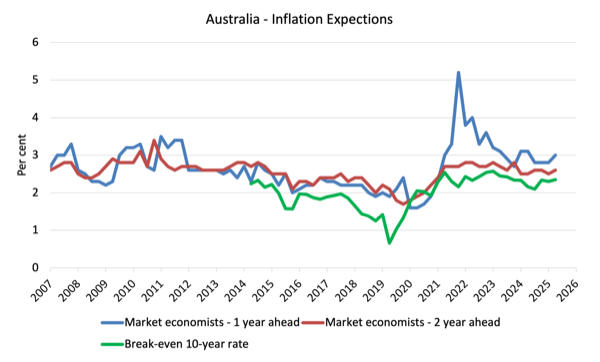
The next graph reveals three measures of anticipated inflation produced by the RBA from the December-quarter 2005 to the March-quarter 2026.
The 4 measures are:
1. Market economists’ inflation expectations – 1-year forward.
2. Market economists’ inflation expectations – 2-year forward – so what they suppose inflation shall be in 2 years time.
3. Break-even 10-year inflation price – The typical annual inflation price implied by the distinction between 10-year nominal bond yield and 10-year inflation listed bond yield. This can be a measure of the market sentiment to inflation danger. That is thought-about probably the most dependable indicator.
They beforehand revealed a fourth measure – Union officers’ inflation expectations – 2-year forward – however this sequence hasn’t been up to date for the reason that September-quarter 2023.
However the systematic errors within the forecasts, the worth expectations (as measured by these sequence) are all nicely throughout the RBA’s targetting vary of 2-3 per cent.
Not one of the time sequence are accelerating upwards at any vital price.
The proof demonstrates that there isn’t a foundation for the RBA’s declare that value expectations are rising.
The shifts are all inside survey sampling errors.
The newest information is proven within the following graph:
The next desk reveals the contributing elements (in factors) to the March All teams CPI inflation end result.
I’ve aggregated the sub-components into the highest degree objects:
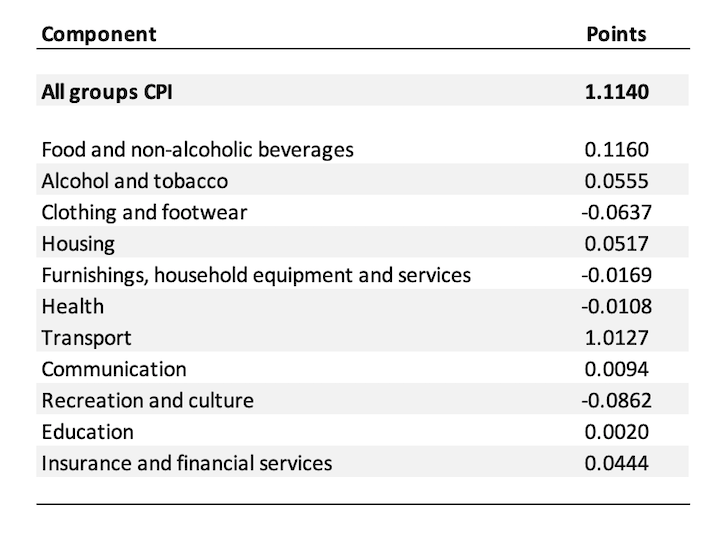 The outcomes are clear:
1. The All teams CPI rose by 1.1 per cent in March – which is kind of vital.
2. Transport contributed 1.01 factors – all personal motoring.
That’s, imported gasoline prices have risen quickly because of the chaos Trump and Netanyahu are inflicting within the Center East.
3. Meals and Alcoholic drinks contributed 0.11 factors.
4. Most almost each different part within the CPI routine demonstrated no vital contribution or have been unfavorable.
Then ask the query:
How will growing home rates of interest do something to cut back the worth of petrol in Australia when the oil and refined merchandise are imported and the prices are being pushed by an exterior battle?
The reply is clear and the RBA is aware of that it’s apparent.
That’s the reason they’re dodging the problem and making spurious claims about “capability points” and “rising expectations” to divert our consideration from the plain.
On the capability problem – in March 2026, the official unemployment price was 4.3 per cent and the underemployment price was 5.9 per cent, given a complete wastage of prepared and out there labour of 10.2 per cent.
Along with the detailed CPI information (which may have revealed particular bottlenecks), the truth that there’s that a lot idle labour tells us that the capability problem (an excessive amount of spending) can be spurious.
The ultimate problem pertains to fiscal coverage.
On the RBA’s press convention on Tuesday asserting the – Financial Coverage Resolution – the Governor mentioned that:
… when governments are spending some huge cash and we’re working up in opposition to capability constraints, then they do want to consider whether or not or not there’s methods they may also help the inflation drawback by on the lookout for methods to constrain demand.
Subsequent week, the Treasurer will ship his annual fiscal assertion outlining spending and tax initiatives for 2026-27.
A lot must be carried out to enhance public infrastructure, restore some credibility to the training system (significantly larger within the wake of latest scandals), cope with the housing disaster, cope with local weather change and all the opposite issues which might be degraded or deteriorating due to years of austerity-minded coverage making.
However the Treasurer is aware of that the RBA Board is stacked stuffed with New Keynesians who soar at shadows and name them ‘capability constraints’ or ‘unanchored inflationary expectations’ and drive up rates of interest.
So he’s caught on this continual dysfunction as nicely – which is partly of his personal making given he’s the one who makes appointments to the RBA administration and coverage board.
He is aware of that if he tries to cope with the non permanent cost-of-living pressure caused by the Center East chaos, the RBA will simply worsen the issue by pushing charges up once more.
Because of this, whereas financial coverage is inflicting harm and redistributing earnings from the low-income debt holders to the high-income holder of monetary property and the financial institution shareholders, fiscal coverage is being prevented from helping the low-income households who’re most uncovered to rising transport prices.
So each arms of coverage are perverted by this most cancers – New Keynesian ideology.
Conclusion
One thing has to offer.
That’s sufficient for at this time!
(c) Copyright 2026 William Mitchell. All Rights Reserved.