


Lots of people prefer to criticize GDP as a measure of dwelling requirements. Amongst many intellectuals, notably within the UK and a few components of North Europe, speaking in regards to the limitations of GDP and making an attempt to think about higher measures is one thing of a cottage business:

Tim Jackson@ProfTimJackson
Our @ConversationUK article with Paul Allin and @DianeCoyle1859 on limitations of the #GDP and (what comes subsequent) is revealed at present #beyondgdp #sna2025
theconversation.com
Past GDP: altering how we measure progress is essential to tackling a world in disaster – three main specialists


3:30 PM · Aug 18, 2022
12 Reposts · 23 Likes
Now, there are essential senses wherein these critics are proper. GDP leaves out some issues which might be essential to human well-being — for instance, leisure time, baseline well being, inequality, pure habitats, and the worth of unpaid home tasks and youngster care. And there are issues it contains that some individuals won’t need to embody — the quantity that authorities spends on tanks and bombs, as an illustration, or the charges individuals pay to lose their cash in DeFi scams. There are even a couple of economists who say we shouldn’t even take note of GDP and that we should always solely care about consumption.
For that reason and others, it’s essential to not get too obsessive about one single measure of the financial system — GDP or anything. You must have a look at a bunch of measures to get a transparent image of what’s taking place (in a 2018 Bloomberg submit, I prompt additionally actual median private revenue, prime-age employment charge, median actual weekly earnings, and the Supplemental Poverty Measure). And in reality, I believe policymakers and media figures everywhere in the world already have a look at numerous completely different numbers.
However at present I simply need to give attention to GDP, as a result of the critics have sorely overstated their case. Actually, GDP is an extremely helpful and essential quantity, for quite a lot of causes.
First, I believe that understanding what GDP truly is helps us perceive why it’s essential. Critics of the idea generally appear to lack a fundamental understanding of what the quantity even means.
GDP is a measure of the whole quantity of financial worth produced in a rustic. We measure financial worth by how a lot individuals pay for stuff. In the event you pay $100 for a brand new toaster, GDP goes up by $100. If the federal government pays $1M for a tank, GDP goes up by $1M.
Now, it may be exhausting to know why we’d care about measuring issues this manner. Simply because individuals pay $100 for one thing, does that imply it was actually value $100? And on prime of that, it might get a bit of difficult, as a result of there are some issues we purchase that aren’t included in GDP — intermediate items (like components to make a automotive), used items, monetary belongings like shares and bonds, and so on. Explaining this stuff would take an entire economics lesson.
However as an alternative, there’s a better approach to consider GDP and what it means. Actually, it’s only a measure of individuals’s incomes.
The important thing to understanding that is to understand that everytime you spend a greenback, another person makes a greenback of revenue. In the event you spend $100 on a toaster at Wal-Mart, a few of that goes to employees’ wages, some goes to suppliers, some goes to the individuals who personal the corporate, some goes to the federal government by way of taxes, and so forth. However all of it goes to somebody. Each greenback that will get spent is a greenback that will get earned.
So if we add up all of the wages, earnings, rental revenue, curiosity revenue, and taxes earned by the individuals in a rustic, that complete ought to simply be the identical as GDP! Magic, proper?
Actually, we do add this stuff up, with a quantity referred to as GDI — “Gross Home Revenue”. Truly we’ve to make some statistical changes to the essential components of wages + earnings + rental revenue + curiosity revenue + taxes, but it surely’s mainly simply that. And guess what — GDI and GDP are virtually precisely equivalent!

The small variations between the numbers are resulting from statistical quirks, however you’ll be able to see that mainly these are the identical quantity.
A rustic’s complete manufacturing is form of an advanced idea, however the complete revenue of all of the individuals in a rustic is a very simple and intuitive concept to know. You could have an revenue. I’ve an revenue. Everyone knows what revenue means, and why it’s essential.
So why can we even trouble to calculate GDP? If GDI is identical factor, why don’t we simply use that? The reply is that it’s simpler and faster to gather knowledge on gross sales than on incomes. GDP is only a handy quantity to calculate. However actually it’s only a measure of revenue.
Now, the part above is how we outline complete GDP — the whole manufacturing (or revenue) of a whole nation. However typically, after we see GDP in contrast between completely different nations, it’s truly per capita GDP — GDP per individual.
Why would we care about GDP divided by the variety of individuals? In principle, median revenue — the revenue of the everyday individual or family — could be a greater measure of the everyday individual’s dwelling requirements. However medians are exhausting to calculate, as a result of they require doing surveys — it’s a must to go on the market and ask everybody how a lot they earn. For growing nations, it’s very exhausting to do these surveys and get dependable outcomes. So as an alternative, we measure per capita GDP, just because it’s quite a bit simpler to measure.
However by measuring the simpler factor, are we actually simply measuring B.S.? Is per capita GDP actually measure of dwelling requirements? For growing nations, the reply seems to be “sure”.
The best way we all know that is that we will examine GDP per capita to numerous different measures of well-being whose significance is evident and straightforward to see. For instance, meals. Everybody eats meals, and one of many huge issues for individuals in very poor nations is easy methods to get sufficient meals. After we have a look at calorie consumption per individual, we see that it’s fairly correlated with GDP — the nations the place individuals get fewer than 2500 energy a day on common are principally fairly poor nations, whereas the locations the place individuals recover from 3000 are principally fairly well-off.
(Be aware: All of those per capita GDP numbers are measured by way of “worldwide {dollars}. It is a measure that tries to account for native worth variations, in order that 100 “worldwide {dollars}” should buy you roughly the identical stuff in Ghana that it might in Singapore. This strategy is known as PPP, or Buying Energy Parity.)

Or take life expectancy. General, as nations get richer by way of per capita GDP, their life expectancy tends to go up. And the nations the place individuals don’t stay very lengthy, by trendy requirements, are all fairly poor by way of per capita GDP:

Or take training. Lots of people suppose that training is an efficient factor for a society to have, and when individuals have the time and sources to ship their children to highschool it’s usually signal. And as with energy and longevity, we see that GDP per capita is correlated with years of training:
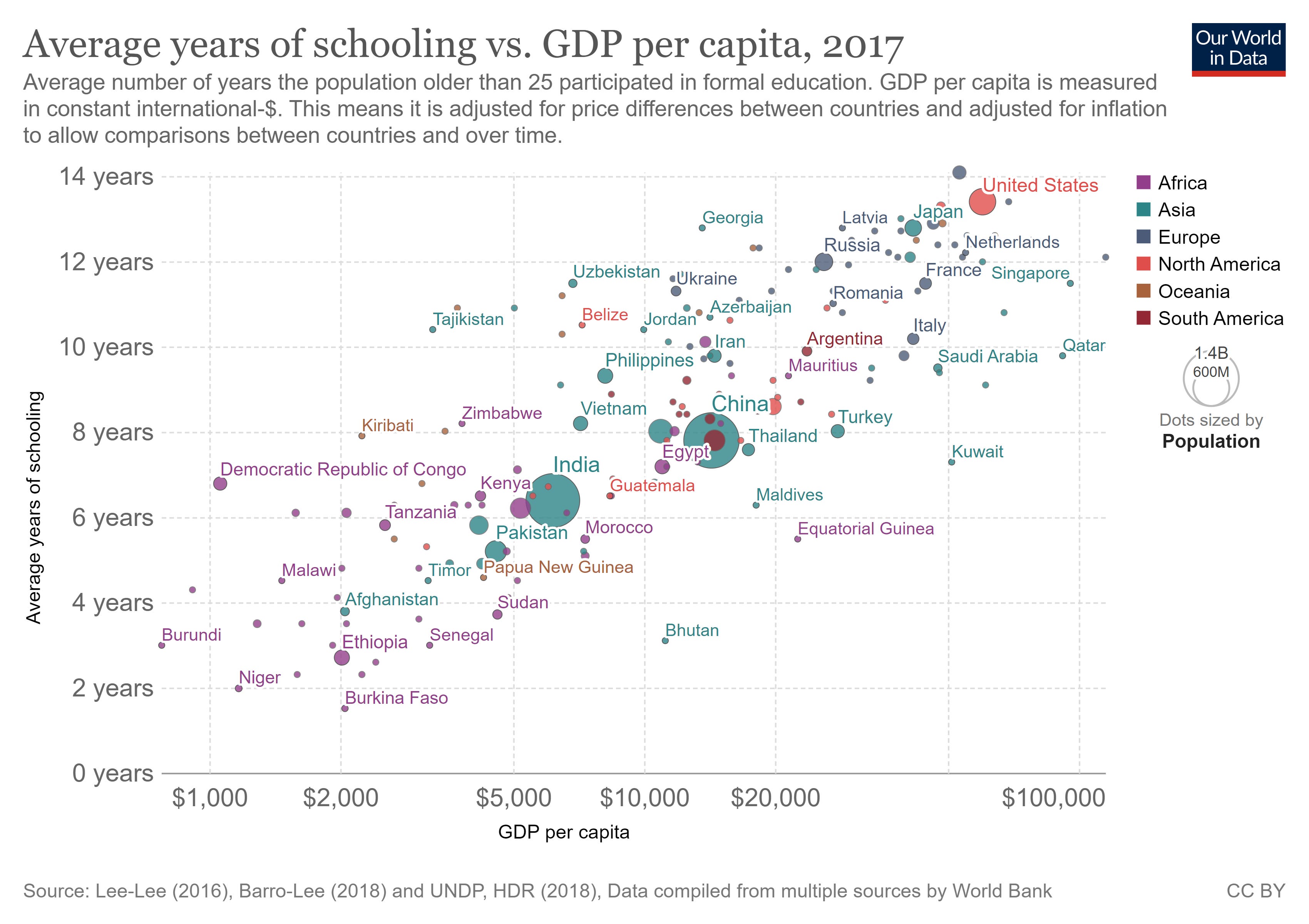
Actually, because of this individuals who tried to give you various, extra well-rounded measures of human well-being usually discover that these are carefully correlated with GDP per capita. The Human Growth Index, which incorporates the measures above together with literacy charges, is an efficient instance.
What’s fairly wonderful is that GDP per capita is even correlated with issues it was by no means supposed to measure. For instance, whenever you ask individuals how glad they’re with life, individuals in nations with larger per capita GDP have a tendency to present larger solutions:
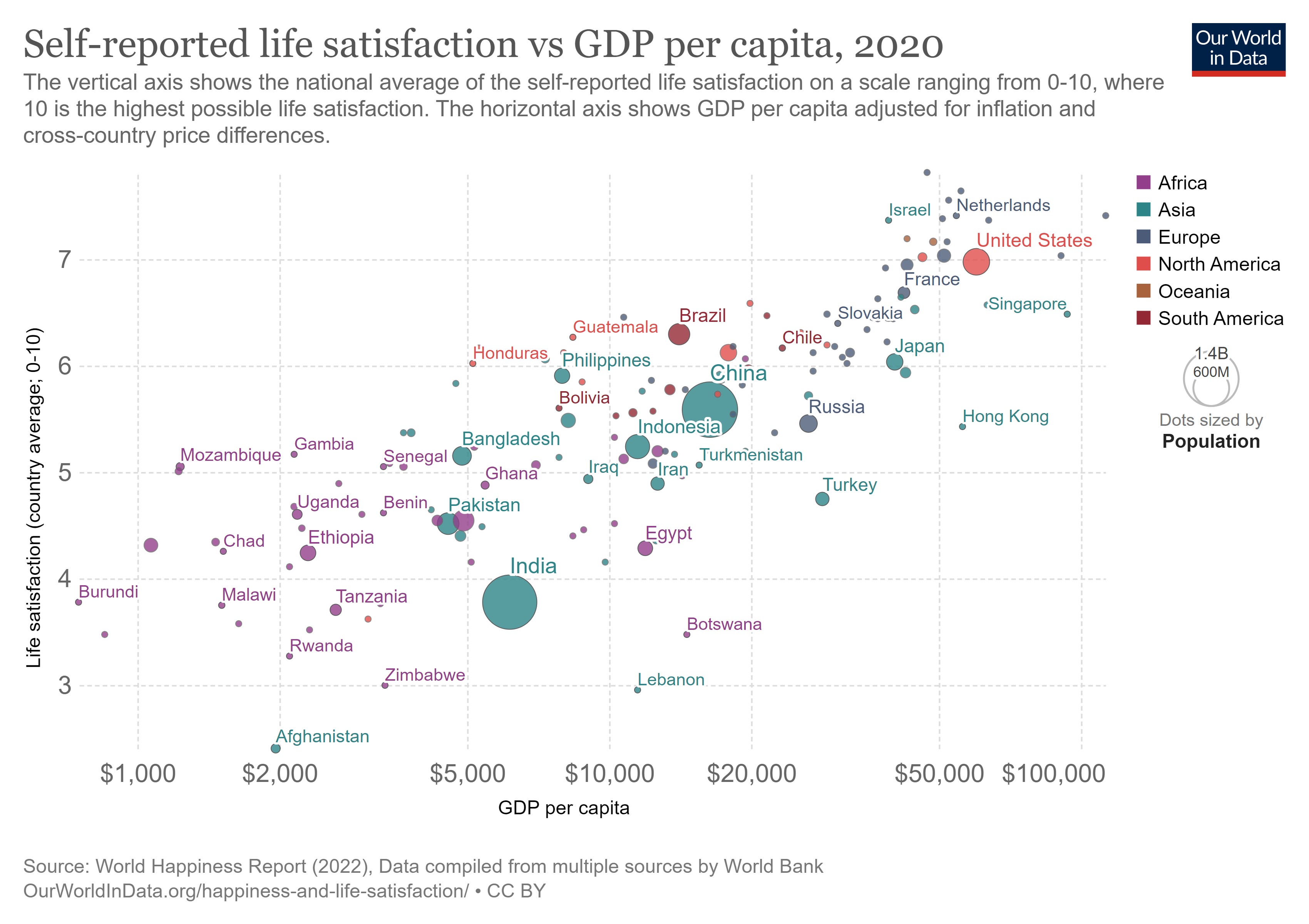
Because of this tasks like “Gross Nationwide Happiness” are unlikely to result in huge advances over GDP by way of measuring a rustic’s well-being.
So GDP per capita is a fairly-easy-to-calculate quantity that’s correlated with every kind of measures of human well-being — meals, well being, training, and happiness. However on prime of that, which nations’ GDP per capita grows quite a bit over time is a fairly good information to which nations appear to have change into extra materially rich and technologically superior. For instance, right here’s a comparability of the per capita GDP of South Korea, Pakistan, and Argentina since 1950:

This suits with our instinct about how these nations economies developed over the long run. South Korea began out impoverished and devastated by battle, however finally grew right into a wealthy technological powerhouse. Pakistan additionally began out poor however stays fairly poor to at the present time. Argentina began out with an revenue that was spectacular for 1950, however which didn’t develop a lot over time, that means that Argentina isn’t thought of a wealthy nation at present. Google some footage of the neighborhoods in these nations’ huge cities, and also you’ll get a good concept.
Actually, there’s a extremely nice web site referred to as “Greenback Road” the place you’ll be able to have a look at footage and movies of typical households at completely different ranges of revenue. GDP per capita isn’t an ideal information to the revenue of a typical household (due to inequality), but it surely’s a tough approximation. Wanting by means of that web site, you’ll be able to clearly see how a lot of a distinction a better revenue makes.
Now, I maintain saying that GDP per capita is an efficient measure of dwelling requirements in growing nations. What about in wealthy nations just like the U.S., Japan, or France? Right here, I believe, GDP remains to be considerably essential, however not as a lot. The reason being that human beings have diminishing marginal utility of wealth — as soon as we get a good place to stay and respectable transportation and some different fundamentals, issues like leisure time and inequality and baseline well being change into extra essential. These issues aren’t measured in GDP. And quality-of-life issues that aren’t totally mirrored in GDP numbers — crime, good climate, good city design, and so forth — additionally loom bigger.
Anybody who has lived in a number of wealthy nations — say, Japan and the U.S. — is aware of that the variations between these nations are usually extra a matter of tradeoffs than uncooked revenue numbers. If you would like nice public transit and low crime and dense city dwelling and nice style, go to Japan. In the event you’d want a giant home and a garden and low-cost gasoline, come to America. On the whole these variations are extra essential than the GDP distinction. Actually, should you have a look at the Human Growth Index, you’ll see that every one the nations with GDP per capita of over $30,000 are clustered up close to the utmost stage of HDI.
For wealthy nations, although, GDP issues for a really completely different motive.
In wealthy nations, you received’t typically hear individuals discuss in regards to the stage of their nation’s GDP per capita. As an alternative, you’ll typically hear about development, which is the share change in GDP from quarter to quarter or yr to yr. Actually, GDP development is so essential in our financial statistics that we simply name it “development”, interval.
Why can we discuss a lot about quarterly or yearly development in wealthy nations? The reply isn’t as a result of it represents a giant change in dwelling requirements; you’re most likely not going to note the distinction between an financial system at $60,000 per capita and an financial system at $62,400 per capita. However neither is it as a result of our legislators and pundits have been brainwashed into an obsession with GDP numbers. The reason being that GDP development is strongly correlated with employment.
The tight correlation between GDP development and unemployment is known as “Okun’s Legislation”, and it’s been recognized for the reason that Sixties. It’s not a legislation of the Universe, after all, however over time it simply retains being true. Generally it seems like the connection is breaking down, but it surely usually reestablishes itself:
What’s the rationale for this correlation? It’s easy: When individuals eat quite a bit and companies make investments quite a bit, that creates demand for labor, and it additionally will increase GDP.
Unemployment is one thing that politicians have a giant motive to care about, as a result of when unemployment is excessive, individuals are inclined to get fairly indignant and vote their leaders out of energy. Even in nations like China the place individuals can’t vote, a surge of unemployment would possibly create standard anger that threatens regime stability.
So rich-country leaders and media figures have motive to speak about — and to care about — financial development. However it’s actually not the one factor they care about. As we’re seeing now, inflation, which if something is exacerbated by quick development, is the large concern. Only a few individuals had been trumpeting America’s quick GDP development numbers again in 2021, as a result of rising costs had been the large ache level.
In different phrases, critics of GDP think about that rich-country leaders are obsessive about GDP development, however this simply isn’t true.
On prime of all these causes, there’s most likely a motive why nations care about their complete GDP: It represents one measure of nationwide energy.
GDP is a successor to an older measure referred to as industrial manufacturing (which we nonetheless do measure, by the best way). The economic manufacturing index was created after World Warfare 1, in response to the statement that the U.S. and the Entente powers finally received not by out-maneuvering however by out-producing their opponents. Later, it was changed with GDP as a result of GDP appeared to present a broader, extra complete measure of a nation’s productive potential. Some individuals do suppose that GDP proved the decisive think about World Warfare 2, when unparalleled U.S. manufacturing prowess sustained the us and floor down Imperial Japan:
Clearly GDP isn’t a one-number abstract of complete nationwide energy, however it’s one factor to take a look at. In my submit evaluating the China-Russia “New Axis” with the U.S. and its allies, I confirmed how they stack up:

Not everybody cares about nationwide energy, however lots of people — particularly nationwide leaders — positively do care.
So the individuals who denounce the idea of GDP are, in my view, losing their effort. Individuals in wealthy nations aren’t obsessive about GDP; it’s one in every of many financial numbers they care about, and that’s accurately. In poor nations, the place the overriding aim is fundamental materials safety and luxury, GDP looms bigger, however that’s additionally accurately. There’ll by no means be one financial quantity to rule all of them, however GDP is an efficient and essential one, and we should always positively maintain it round.