




Do you wish to create a sensible technique in your firm’s IPO, however you’ve got choices and shares and RSUs, you don’t understand how they match collectively, and all of it simply appears irreducibly complicated?
Possibly a case examine will likely be useful, for example how one girl got here up with an excellent resolution for her particular life and fairness particulars. My shopper, let’s name her Mia, has labored for an organization, let’s name it FinTech, Inc., for 5 years. Earlier this 12 months, it went public. Collectively we created a method that she has partly executed up to now.
We abided by these priorities when creating the technique for Mia. That is doubtless a wholesome start line for you, too.
- Outline what this cash is for in her life (i.e., outline her important objectives; what does she must really feel protected, to really feel fulfilled).
- Promote sufficient firm inventory to completely fund these objectives.
- Reduce taxes whereas doing this.
- Take into account protecting firm inventory solely to the extent she doesn’t want the cash for a necessary aim.
To be sure you are actually understanding the which means of “priorities” right here: minimizing taxes is much less vital than promoting firm inventory to fund her objectives. Sure, she would possibly make some tax-inefficient choices alongside the way in which!
Some individuals have already got a listing of issues and experiences they wish to spend cash on: shopping for a home, funding a child’s faculty financial savings account, doing a transform, taking a sabbatical, and so on. These individuals ought to give attention to getting sufficient cash out of firm inventory and into money or a diversified portfolio ASAP, invested in a method and in an quantity that’s acceptable for these objectives.
Clearly outlined objectives make this a part of the sport fairly straightforward. In my expertise, it’s very easy to persuade somebody to promote their firm inventory in the event that they get a home out of it, or a sabbatical, or one thing that’s personally significant to them. Convincing them to promote their inventory after they don’t have any well-defined want for it…effectively, it’s much less convincing.
That is the state of affairs Mia was in. She has no such clearly outlined objectives. She has extra of a “I wish to have robust funds in order that I’ve extra selection and adaptability sooner or later” perspective about cash.
In my world, that meant promoting a bunch of the corporate inventory (not essentially all of it, however a bunch) to place it in a sturdy money emergency fund and a diversified portfolio that will likely be much less risky sooner or later than a single inventory can be. Fortunately, Mia was amenable to that. She didn’t maintain any robust emotions in regards to the inventory.
So, she had an overarching technique for her work with firm inventory: Get sufficient cash out of the corporate inventory to construct:
- A sturdy money cushion. (This gives near-term flexibility and safety.)
- A retirement portfolio sufficiently big to provide her a sturdy stage of economic independence. Not absolutely financially unbiased, however financially unbiased sufficient. She focused attaining “Coast FIRE” (having a sufficiently big retirement portfolio that she wouldn’t want to avoid wasting any extra to it), assuming she’d retire16 years from now. (This gives long-term flexibility and safety.)
She may assign a greenback worth to every. In Mia’s case, she determined to make it:
- 1 12 months’s value of bills, in money ($100k)
- her present retirement portfolio, she wanted a further $700k to be Coast FIRE.
She wanted $800k, after tax, out of this IPO. (Sure, these are each considerably arbitrary targets. But in addition cheap, a mix that characterizes many vital monetary choices.)
Between the 2, Mia will now have far more freedom to make life and profession decisions that aren’t motivated primarily by “how do I make some huge cash?”
For those who’re doing this your self, write these objectives down and put a greenback quantity subsequent to them. It’s remarkably useful, in my expertise, to have a visually clear listing of the greenback goal and the “why.”
Guidelines of the IPO
FinTech, Inc. had a reasonably normal (for the fashionable period) IPO setup:
- Double-trigger RSUs absolutely vested on IPO day.
- Workers couldn’t promote any shares till six months after IPO day (i.e., there was a six-month lockup). They may train choices however must maintain the shares after train).
- If the inventory value hit sure fascinating targets, there can be a mid-lockup, one-week-long buying and selling window.
- Throughout that restricted buying and selling window, staff may promote 25% of their complete possession as measured on IPO Day. We calculated that Mia “owned” 100,000 shares (between outright shares, vested choices, and RSUs vesting on IPO day). She was due to this fact allowed to promote 25,000 shares.
Technique within the Years Earlier than the IPO
In annually main as much as the hoped-for-but-we-don’t-really-know IPO, Mia exercised some ISOs. If in case you have actually low-cost choices, the higher boundary of this train ought to doubtless be the variety of ISOs you can train with out triggering Different Minimal Tax.
In Mia’s case, the train value was kinda dear ($10). So, Mia selected an sum of money that she felt good shedding fully (as a result of that’s what she risked by exercising choices in a personal firm, particularly one with no particular plans for a liquidity occasion), and he or she exercised as many choices as that might purchase. Seems, that was all the time beneath the AMT threshold. She ended up exercising solely a small fraction of her ISOs by the point the IPO rolled round.
(By the way in which, regardless of the potential tax awesomeness of exercising ISOs early, it was cheap for Mia to train so few ISOs. Any cash you set into exercising private-company choices is cash you danger shedding all of. It’s, in actual fact, fully rational to delay exercising all choices till it’s also possible to promote the ensuing shares. Though it limits your upside (as a result of your tax fee will likely be larger), it eliminates your draw back.
Going into the IPO, she had:
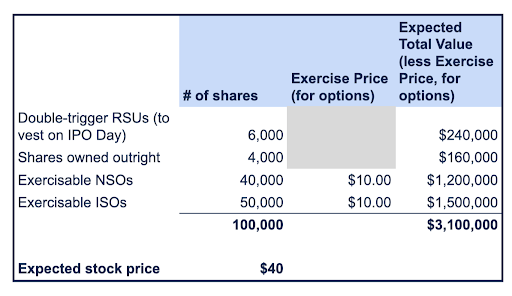
Principally, she had each kind of fairness comp you can think about. How ought to she make the very best choices throughout the complete suite of fairness comp, not only for one kind at a time?
Technique Proper Earlier than the IPO: Select RSU Withholding
Main as much as the IPO, Mia had one massive determination to make: When her RSUs vested on IPO day, she may default into the statutory 22% withholding fee for federal revenue taxes on the RSU worth, or she may select to withhold 37%.
Regardless that Mia didn’t have a lot in the way in which of RSU shares—which meant that this selection didn’t contain quite a lot of {dollars}—she selected to have 37% withheld. Why?
- This decreased her “focus danger” sooner. We had no concept what was going to occur to the inventory value earlier than she’d be capable of promote any shares. If the inventory listed at $50 and dropped to $20, she would have successfully “offered” at that larger $50. Yay! Even when the inventory value ended up rising, she at the very least didn’t have to fret about it within the meantime.
- Regardless that her RSU revenue wasn’t going to be massive this 12 months (meriting the best tax-bracket withholding), she had plans for exercising NSOs, and that would make her revenue excessive (and due to this fact tax fee excessive) this 12 months.
Technique Through the Lockup and Proper After: Flip Firm Inventory into Money ASAP
After IPO Day, when the principles had been in place and we had some sense of the inventory value after the corporate went public, that’s when many of the strategery may usefully occur.
RSUs that Vested on IPO Day
When the particular, restricted buying and selling window opened up in the course of lockup, she wished to diversify (begin promoting).
As a result of Mia’s RSUs had been “double set off,” (which is the norm for private-company RSUs), all of Mia’s 6000 time-vested RSUs had absolutely vested on IPO Day. Nearly 50% of the RSUs had been withheld (between state revenue tax and 37% federal tax), so Mia then owned 3000 shares from that vesting.
Main as much as the restricted buying and selling window, she didn’t know precisely what she was going to do with these shares. We made this plan:
- If the corporate inventory rose in value for the reason that IPO, she’d hold it, so she wouldn’t pay the upper short-term capital positive aspects tax on that achieve, as she’d solely held the shares for a couple of months. We’d must promote extra of different sorts of shares to fill that 25,000.
- If the corporate inventory fell in value for the reason that IPO, we’d promote it. She wouldn’t incur any tax invoice (though wash gross sales would doubtless imply she couldn’t profit from that tax loss till future years). This could imply we’d promote fewer of the opposite sorts of shares to fill that 25,000.
Because it seems, the inventory value fell from IPO to restricted buying and selling window. It had IPOed at $40 and was right down to $30, so she offered these 3000 shares she had from IPO Day RSU vesting. These ended up being the tax-wise least expensive shares to promote…as a result of she offered them at a loss.
She had now offered 3000 of the permitted 25,000 shares.
Shares She Already Owned
Mia owned 4000 shares of firm inventory. She offered all of them in the course of the restricted buying and selling window.
As a result of Mia had already owned these shares for at the very least one 12 months, she would get the decrease, long-term capital positive aspects tax fee when she offered them. These had been the second least expensive shares tax-wise to promote.
Had Mia had important charitable intentions, she may need stored these shares to donate (as a substitute of money), as a result of that’s tax awesomeness.
One factor that didn’t apply to Mia however would possibly to you: For those who acquired the inventory early sufficient within the firm’s timeline, it is likely to be Certified Small Enterprise Inventory (QSBS), which might get rid of most and even all federal capital positive aspects tax on the achieve once you promote. So, earlier than you promote, be sure you know the inventory’s QSBS standing!
She had now offered 7000 of the permitted 25,000 shares.
Exercisable NSOs
To promote the remaining 18,000 of the permitted 25,000 shares, she regarded to her NSOs. Since you owe revenue tax (on the “unfold” between train value and honest market worth) the second you train, it prices some huge cash to train 18,000 NSOs ($10 x 18,000; plus taxes on the unfold). However as a result of she offered on the identical time (and he or she may put aside a number of the money proceeds to pay the taxes), Mia didn’t put any of her present wealth in danger.
It is best to know that there is no such thing as a good motive to train and maintain NSOs (in a public firm). So, when Mia exercised, it was assumed that she would additionally promote. Learn my favourite weblog put up on this subject.
We additionally took into consideration the concept of the “leverage” her choices supplied (leverage = train value / honest market worth). NSO leverage isn’t a very intuitive idea (at the very least, to not me!) nevertheless it boils right down to this: It will be foolish to train the choices at $10 if the honest market worth had been solely $11. You solely get, in a way, $1 of worth. That leverage is excessive ($10/$11 = 91%). It’s higher to attend till you get extra bang in your train buck.
Through the buying and selling window, nevertheless, the inventory value was $30, so leverage was 33% ($10/$30). Leverage under 40% makes it worthwhile, as a rule of thumb.
RSUs as They Vest, Now in a Public Firm
One of many difficult transitions when your organization goes from non-public to public is how your RSUs work. When your organization is non-public, normally you haven’t any management over RSUs and do nothing. It’s simply Future Fantasy Cash. As soon as your organization is public, when these RSUs attain their vesting date…
- They instantly flip into inventory.
- They’re handled as taxable revenue.
- You may promote them for precise {dollars}.
- You most likely don’t have sufficient taxes withheld on the vest and can due to this fact find yourself with shock tax payments.
The greatest observe for RSUs, in public firms, after they vest is: Promote ASAP. And that is what Mia is doing. Bear in mind, there is no such thing as a tax profit to holding RSU shares after they vest. No actually.
Bear in mind, so long as Mia stays an worker, she is going to proceed to get new inventory by way of RSUs vesting. So, regardless of the destiny of the corporate inventory, she is going to share in it by way of the worth of these RSUs upon vest, even when she had been to promote all the remainder of her inventory.
Exercisable ISOs
I take into account ISOs probably the most difficult of fairness comp varieties, so I go away it for final, each on this weblog put up, and in Mia’s technique normally.
ISOs have this superior tax therapy of not incurring tax at train so long as you keep underneath the Different Minimal Tax threshold. (Do not forget that that is in distinction to exercising NSOs; tax is all the time due once you train NSOs.) Additionally, so long as you maintain the inventory for at the very least a 12 months after train, you’ll get the decrease long-term capital positive aspects tax fee on the achieve once you ultimately promote.
Add on high: That AMT threshold, normally, goes up the upper your strange revenue is. So, with the RSUs that vested at IPO and proceed to vest each quarter now that the corporate is public, and particularly with the train of NSOs, she now has a really excessive strange revenue this 12 months.
What does that imply for Mia’s ISO technique? It permits her to train (and maintain…to get the tax advantages) a bunch of ISOs with no tax invoice.
What number of? Welp, that is the place she introduced in her CPA and requested them to mannequin what number of ISOs Mia can train with out triggering AMT. Thanks, CPAs with equity-comp experience and a service mannequin that features an annual tax projection!
I nonetheless suggested Mia to solely train as many ISOs this 12 months as she may with out triggering AMT. Why?
- She doesn’t plan to go away the corporate within the close to future, so she ought to have future years by which to proceed to train the ISOs. (After you allow an organization, your ISOs would possibly outright expire. But when they don’t, they will convert, by regulation, to NSOs after 90 days.)
- This retains her danger of shedding cash with the corporate inventory decrease. Positive, she’s placing that exercise-price cash in danger, however she’s not additionally placing tax cash in danger.
Sure, this can add to her assortment of firm inventory (in battle with our basic aim of decreasing the focus). She is knowingly rising focus danger as a result of the attainable tax advantages are so good. By itself, that doubtless wouldn’t be sufficient, however this is just one half of a bigger technique of promote, promote, promote.
I discover this little bit of psychological accounting useful: Mia isn’t placing any of her present wealth in danger. The cash she’s risking by exercising and holding ISOs is cash she bought from promoting different FinTech, Inc. inventory.
[Side note: AMT is not to be avoided at all costs under all circumstances. There are situations in which exercising a bunch of ISOs and triggering AMT is a reasonable choice. If you pay AMT this year, you get an AMT credit and it’s possible to get that credit back in future years. That said, it still puts you at higher risk of loss. You’re spending more money to buy stock…whose price might then drop.]
Technique in 2026 and Past: She Can Be a Bit Extra Nuanced
Bear in mind our high-level technique:
Precedence #1 = Promote sufficient inventory to fund objectives.
Precedence #2 = Reduce taxes.
What does this prioritization appear like in observe? In Yr 1, promote promote promote. In Years 2+, as soon as she has funded her objectives from these Yr 1 gross sales, she will select to decelerate the gross sales and let tax issues (or risk-taking) drive the bus extra typically.
What is going to she do along with her RSUs? Mia will proceed to promote them as they vest in 2026 and past, so long as she stays at FinTech, Inc. As a result of, to repeat the message, there is no such thing as a tax benefit in holding on to RSUs after they vest.
What is going to she do with the shares from exercised ISOs? These are solely shares she is going to maintain. She’s going to hold on to them for a full 12 months (to get the decrease tax fee on the positive aspects) after which promote. If Mia develops a charitable plan within the meantime, these ISO shares (assuming the honest market worth is larger than their $10 value foundation) will doubtless be the issues she ought to donate to charity, not money.
What is going to she do along with her exercisable choices? Annually she begins the NSO/ISO dance once more:
- She workouts (and sells) some NSOs (so long as leverage < 40%).
- If she desires to prioritize taxes over diversification, she may scale back the variety of NSOs she workouts to be able to hold her revenue under a sure tax fee. (Her CPA may help her calculate simply what number of NSOs that’s.)
- Then she sees what number of ISOs she will train (and maintain) with out triggering AMT.
She now has way more flexibility in how she treats firm inventory:
- Maintain extra: If she has an emotional connection to the inventory, or doesn’t wish to promote all the pieces as a result of “what if?!”, then cool, let’s go away extra NSOs unexercised or let’s hold some exercised ISO shares previous the one-year date.
- Maintain much less/none: Statistically talking, any focus in a single inventory will increase your danger with out a concomitant enhance in your reward. 100% diversification (i.e., getting out of all of her inventory) is her greatest probability of getting profitable long-term investing. This, by the way in which, is the place I stand. However I don’t impose this angle on purchasers when their life objectives don’t require it.
There’s extra element to the “2026 and past” technique, however I’m protecting issues brief and easy right here for the sake of digestibility.
Right here’s a abstract of Mia’s technique by kind of fairness:
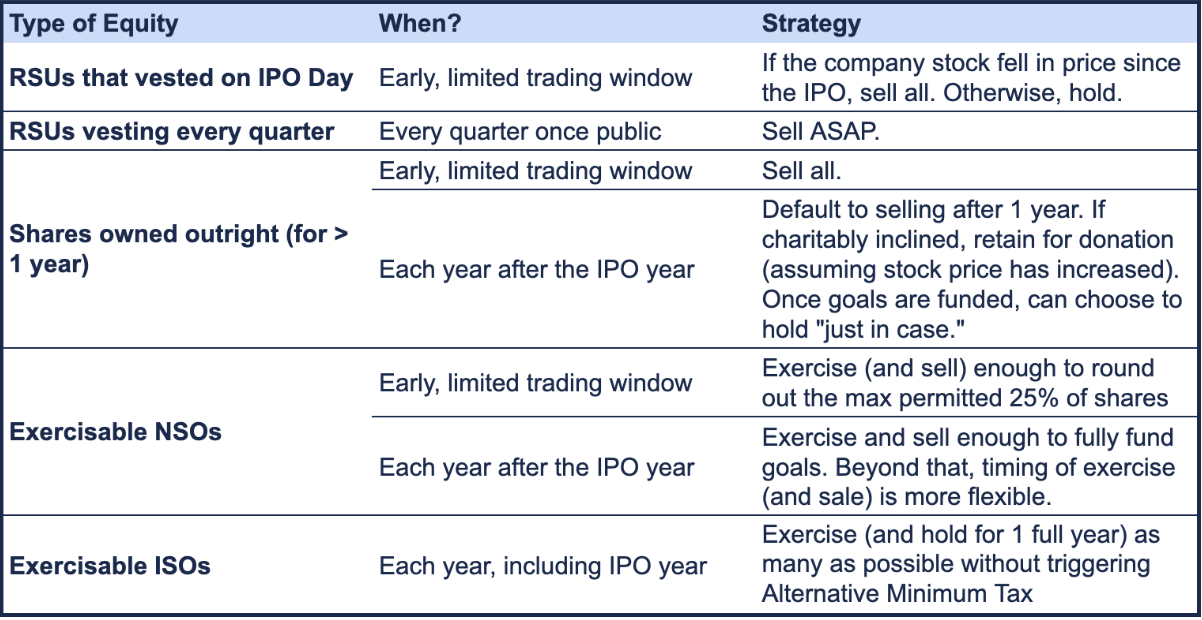
Feeling overwhelmed? I’m not shocked.
Have a greater sense that each one these items can and may match collectively? I hope so.
Satisfied of the first significance of clarifying what this cash is for in your life, and of orienting all of your choices round supporting that? Good.
If you wish to work with a monetary planner who may help information you thru your IPO in a method that feels proper and true, attain out. Even when I can’t make it easier to myself, I Know Individuals.
The put up A Case Examine in Navigating an IPO appeared first on Stream Monetary Planning, LLC.