

Kajaria Ceramics Ltd. – India’s No.1 Tile Firm
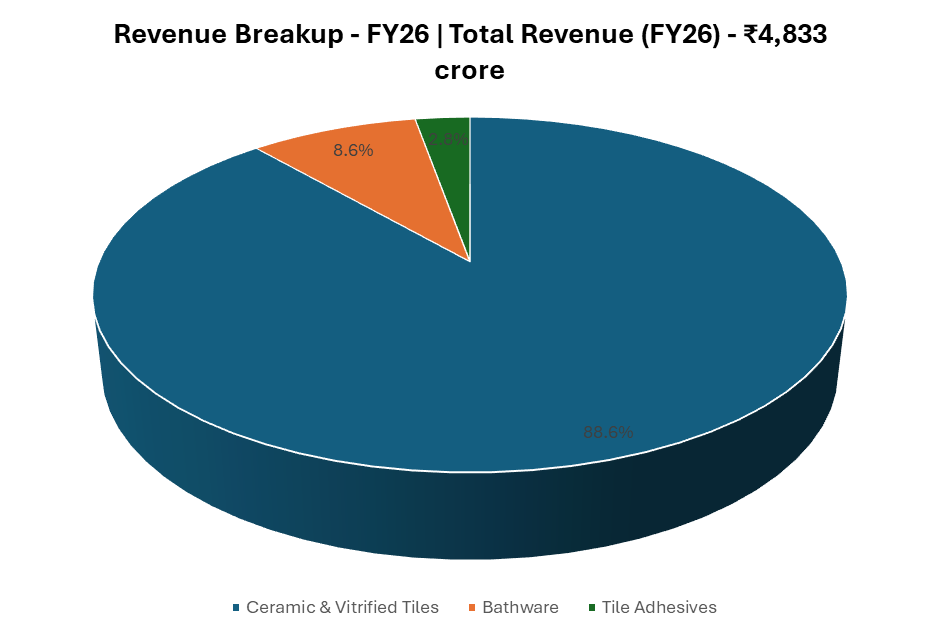
Kajaria Ceramics Restricted, integrated in 1985 and headquartered in Gurugram, is India’s largest producer of ceramic and vitrified tiles and the eighth largest globally. The enterprise falls inside a single reportable section, tiles, spanning ceramic wall and flooring tiles, polished vitrified tiles and glazed vitrified tiles, alongside a bathware and adhesives portfolio reported beneath others, which covers sanitaryware and taps bought beneath the Kajaria and Kerovit manufacturers. Put in tile capability stands at 82.70 MSM every year throughout eight vegetation – Gailpur (35.95 MSM) and Malootana (6.50 MSM) in Rajasthan, three models at Morbi in Gujarat (17.90 MSM mixed), Sikandrabad in Uttar Pradesh (8.80 MSM), Srikalahasti in Andhra Pradesh (8.80 MSM) and Balanagar in Telangana (4.75 MSM) – excluding an additional 5.10 MSM at Kajaria Ramesh Tiles, its 50% Nepal three way partnership. Bathware capability contains 12 lac items every year of sanitaryware throughout two Morbi models and 1.60 million items every year of taps at Gailpur, whereas tile adhesive capability of 9,000 MT per 30 days every is operational at Gailpur and, since Might 2026, at Erode in Tamil Nadu.
Merchandise and Providers
The corporate’s primary merchandise embrace tiles, taps, sanitaryware and tile adhesives.
Subsidiaries: As of FY26, the corporate has 10 subsidiaries and three joint ventures.
Funding Rationale
- Capability growth to drive development and enhance value effectivity – Kajaria is stepping up capex to assist double-digit quantity development, with ₹400 crore capex deliberate for FY27. Key initiatives embrace the ₹210 crore Srikalahasti growth and ₹165 crore Bhiwadi growth, with commissioning anticipated throughout FY27/early FY28. The corporate has additionally permitted 11 MSM of extra capability at Gailpur, pushed by rising demand from the North and East, whereas a ten MSM high-value product line at Srikalahasti is being commissioned. The brand new capacities will enhance product combine, incorporate newer expertise and decrease manufacturing prices, making them high-ROCE accretive. With present tile capability of 82.7 MSM, these investments present vital capability headroom and are anticipated to assist sustained quantity development, higher margins and improved capital effectivity.
- Margin growth aided by gas-price-led business consolidation – Sharp enhance in Morbi fuel costs is strengthening organised gamers’ aggressive place: Fuel costs in Morbi have elevated sharply from round ₹47 – 48/SCM to ₹86 – 88/SCM, leading to a considerably larger value burden for Morbi-based producers. Consequently, Morbi gamers have needed to elevate tile costs by ~40 – 45%, in contrast with solely ~10 – 11% worth will increase at Kajaria’s North and South vegetation, considerably narrowing the historic worth hole with the unorganised market. The sharp rise in enter prices, coupled with higher pricing self-discipline, is prone to speed up consolidation within the tile business, as smaller/unorganised Morbi producers face stress on viability and competitiveness. YoY common ROE has improved from 15.57% to 21.51% and ROCE has improved from 20.3% to twenty-eight.08%. This gives organised gamers equivalent to Kajaria with a chance to realize market share whereas supporting sustained margin growth by higher pricing, product combine and price optimisation.
- Q1FY27 – On a consolidated foundation, Kajaria reported income from operations of ₹1,328.08 crore in Q1FY27, up 20.4% YoY from ₹1,102.74 crore in Q1FY26. Quantity development of 6% YoY was held again by a really weak April, and the majority of the income enhance was pushed by worth will increase moderately than quantity. EBITDA rose 41.0% YoY to ₹260.33 crore with margin increasing ~288 bps to 19.60% from 16.72%, and revenue after tax attributable to homeowners grew 55.5% to ₹169.46 crore from ₹108.98 crore, helped by flat depreciation of ₹42.24 crore and finance prices of ₹5.00 crore. Progress was broader than tiles alone: tile section income rose 17.5% to ₹1,159.40 crore and section end result to ₹197.42 crore, whereas the others section – bathware, sanitaryware and adhesives – rose 44.9% to ₹168.68 crore with section end result at ₹20.72 crore. Web money improved to ₹985 crore at June 2026 from ₹793 crore at March 2026 (internet debt to fairness of -0.30x) and dealing capital days decreased to 46 from 59 a yr earlier.
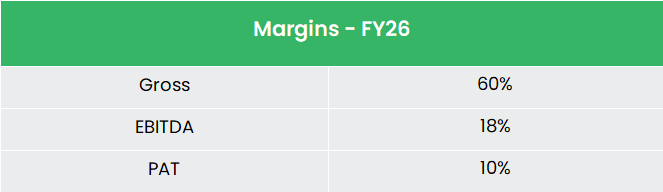
- FY26 – Throughout FY26, consolidated whole gross sales grew 3% YoY to ₹4,832.50 crore from ₹4,683.24 crore, on tile gross sales volumes of 118.52 MSM (up 3% from 114.69 MSM) at the same time as personal manufacturing fell 4% to 84.59 MSM; income from persevering with operations, excluding the discontinued plywood enterprise, was ₹4,830.36 crore. Profitability improved effectively forward of the topline: EBITDA rose 44.3% to ₹861.95 crore with margin increasing ~508 bps to 17.84% from 12.76%, and revenue earlier than share of JV revenue, distinctive gadgets and tax rose 60.7% to ₹722.78 crore. Revenue after tax attributable to homeowners elevated 64.9% to ₹485.41 crore from ₹294.36 crore, after an distinctive lack of ₹44.02 crore towards ₹14.50 crore in FY25. The restoration was progressive by the yr, with quarterly EBITDA margin rising from 16.72% in Q1FY26 to 19.19% by Q4FY26.
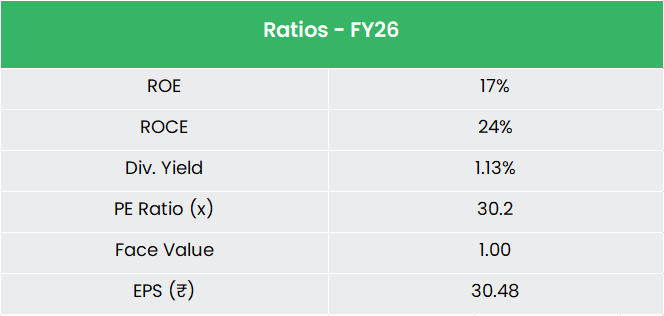
- Monetary Efficiency – The three-year income and internet revenue CAGR stand at round 3% and 14% respectively, the topline reflecting a weak tile-demand cycle whereas earnings recovered on margin growth. The corporate is successfully debt-free, holding internet money of ₹985 crore at June 2026 towards borrowings of ₹229 crore at March 2026. The three-year common ROE and ROCE are round 15% and 20% respectively for the FY23-26 interval, enhancing to 18% and 23% in FY26, and money era is robust, with FY26 working money circulation of ₹664 crore and free money circulation of ₹563 crore.
Trade
India’s actual property sector, the principal demand driver for tiles, bathware and constructing supplies, contributed practically 7.30% to GDP as of November 2025 and remained the nation’s second-largest employment generator. The market was valued at ₹54.96 lakh crore (US$ 650 billion) in 2025 and is projected to succeed in ₹553.38 lakh crore (US$ 5.80 trillion) by 2047, with the residential section alone anticipated to ship new properties value ₹86.44 lakh crore (US$ 906 billion) by 2034 and housing demand reaching 93 million models by 2036. In H1 2026, India’s eight largest residential markets recorded 171,471 house gross sales towards 187,350 launches, whereas FY25 noticed roughly 406,889 properties delivered throughout the highest 9 cities, a 33% enhance over 306,600 models in FY24. Development stays among the many largest FDI recipients, attracting ₹2,81,161.95 crore (US$ 38.74 billion) in building actions and ₹1,39,475.21 crore (US$ 27.55 billion) in building growth between January 2000 and March 2026. Inside constructing supplies, the home tile business remained subdued by a lot of FY26 on pricing stress from the unorganised sector, although business volumes are anticipated to contract within the present yr at the same time as worth grows, as share shifts in direction of branded producers.
Progress Drivers
- Urbanisation and Premiumisation of Housing: India’s city inhabitants is projected to rise from 522.4 million in 2025 to 607.3 million by 2030, with the World Financial institution estimating 600 million city residents by 2036, or roughly 40% of the inhabitants. Premium housing now leads the cycle, with properties priced above ₹1 crore accounting for 71% of residential gross sales in Q1 2026 towards 59% a yr earlier, and launches in that section up 45% YoY, lifting per-unit consumption of higher-realisation vitrified and large-format surfaces.
- Authorities Capex, Inexpensive Housing and GST 2.0: Public capital expenditure has been raised 11.5% to ₹12.22 lakh crore (US$ 138.3 billion) in FY27, whereas the Ministry of Housing and City Affairs allocation rose 50% to ₹85,522 crore (US$ 9.68 billion). Any building sector funding impacts 275 linked constructing supplies, elements and equipment industries. GST 2.0 is predicted to scale back building prices by 3.5 – 4.5% and housing costs by 5 – 8%, whereas the RBI’s December 2025 repo reduce to five.25% additional helps affordability.
- Formalisation and Export Corridors: Sharply larger fuel costs have pressured widespread shutdowns and the Morbi cluster’s first vital worth hikes, compressing unbranded provide and narrowing the value hole towards nationwide manufacturers; as that hole compresses, choice is predicted to shift decisively in direction of branded merchandise. Globally, the phased withdrawal of Chinese language export subsidies and India’s widening FTA community are opening new export corridors, with rising export volumes drawing down home stock.
Peer Evaluation
Rivals: Somany Ceramics Ltd, Cera Sanitaryware Ltd, and many others.
Kajaria is the most important firm within the peer set and the one one working tile capability at scale by wholly and majority-owned vegetation. That scale exhibits up in profitability: Kajaria’s Q1FY27 consolidated EBITDA margin of 19.6% compares with roughly 12% for Somany and 10% for Cera, and it boasts one of the best return profile within the peer set. The steadiness sheet reinforces the hole – Kajaria held internet money of ₹985 crore at June 2026, whereas Somany’s ₹374 crore of borrowings at March 2026 soak up round ₹46 crore of annual curiosity towards trailing working revenue of about ₹296 crore, the principal motive its return ratios display screen lowest.

Outlook
Kajaria is effectively positioned to learn from the continuing shift in direction of organised tile producers, as sharply larger pure fuel costs in Morbi have narrowed the value differential between Kajaria and Morbi merchandise to beneath 20% from ~40% earlier. This improves the competitiveness of branded tiles and will drive market-share positive aspects as smaller unorganised gamers face stress on prices and profitability. The corporate is strengthening its distribution community and increasing its undertaking enterprise, whereas its deliberate capability additions at Srikalahasti and Gailpur will assist larger volumes and enhance value effectivity. Administration has guided for double-digit quantity development over the subsequent 9 months of FY27 and expects 18 – 19% EBITDA margins and ₹1,000 crore+ working EBITDA for FY27. With ~₹400 crore of FY27 capex and enhancing product combine, Kajaria is positioned for sustained quantity development, margin growth and stronger return ratios.
Valuations
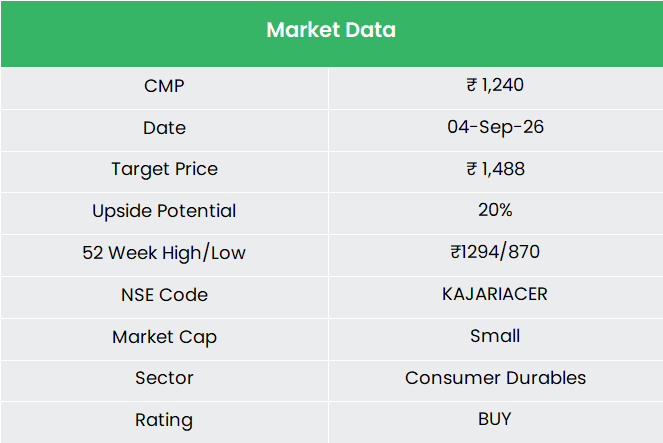
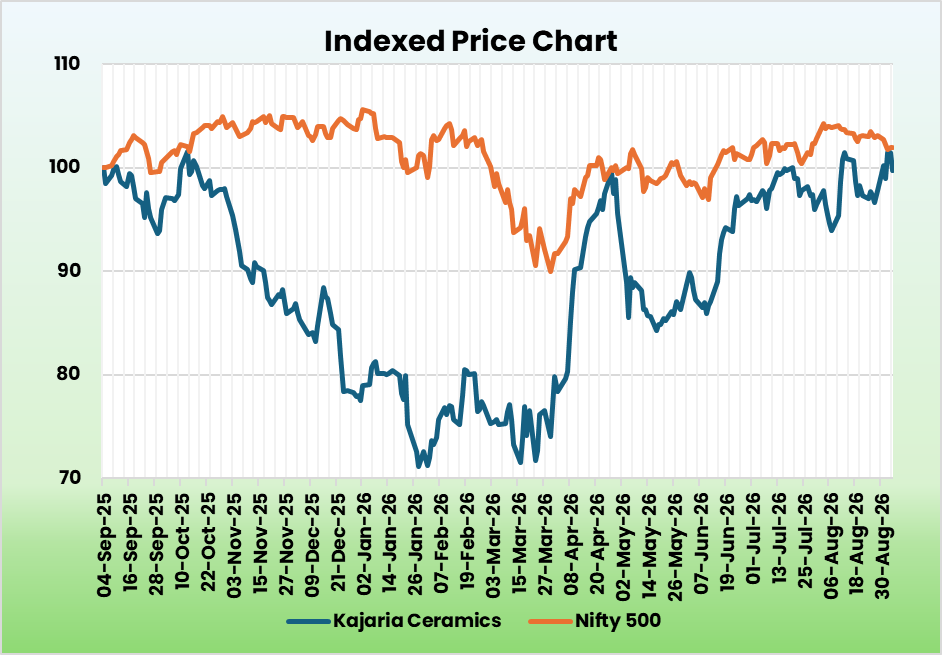
Given its place as the most important organised participant within the tiles business and sustained demand tailwinds, we anticipate Kajaria Ceramics Ltd to retain its market management. We advocate a BUY ranking within the inventory with the goal worth (TP) of ₹1,488, 38x FY28E EPS. We additionally encourage sustaining a stop-loss at 20% from the entry worth to handle potential draw back danger successfully.
SWOT Evaluation
| Energy | Weak point |
|
|
| Alternatives | Threats |
|
|


Disclaimer: Investments within the securities market are topic to market dangers, learn all associated paperwork rigorously earlier than investing. Securities quoted listed here are exemplary, not recommendatory. Please seek the advice of your monetary advisor earlier than investing. Please word that we don’t assure any assured returns for the securities quoted right here.
Analysis disclaimer: Funding within the securities market is topic to market dangers. Learn all of the associated paperwork rigorously earlier than investing. Registration granted by SEBI, and certification from NISM on no account assure the efficiency of the middleman or present any assurance of returns to traders.
For extra particulars, please learn the disclaimer.
Different articles you might like
Put up Views:
154