


Retirement planning is commonly a cornerstone of a shopper’s monetary plan, with advisors estimating how a lot the shopper can safely spend in retirement. In apply, advisors sometimes start with the shopper’s goal retirement date, after which regulate levers akin to withdrawal charges, asset allocation, and spending flexibility to make the plan work. However when the retirement date is handled as fastened, an vital a part of the planning drawback could also be left unexamined: whether or not the timing of retirement itself helps or hurting the plan from the outset.
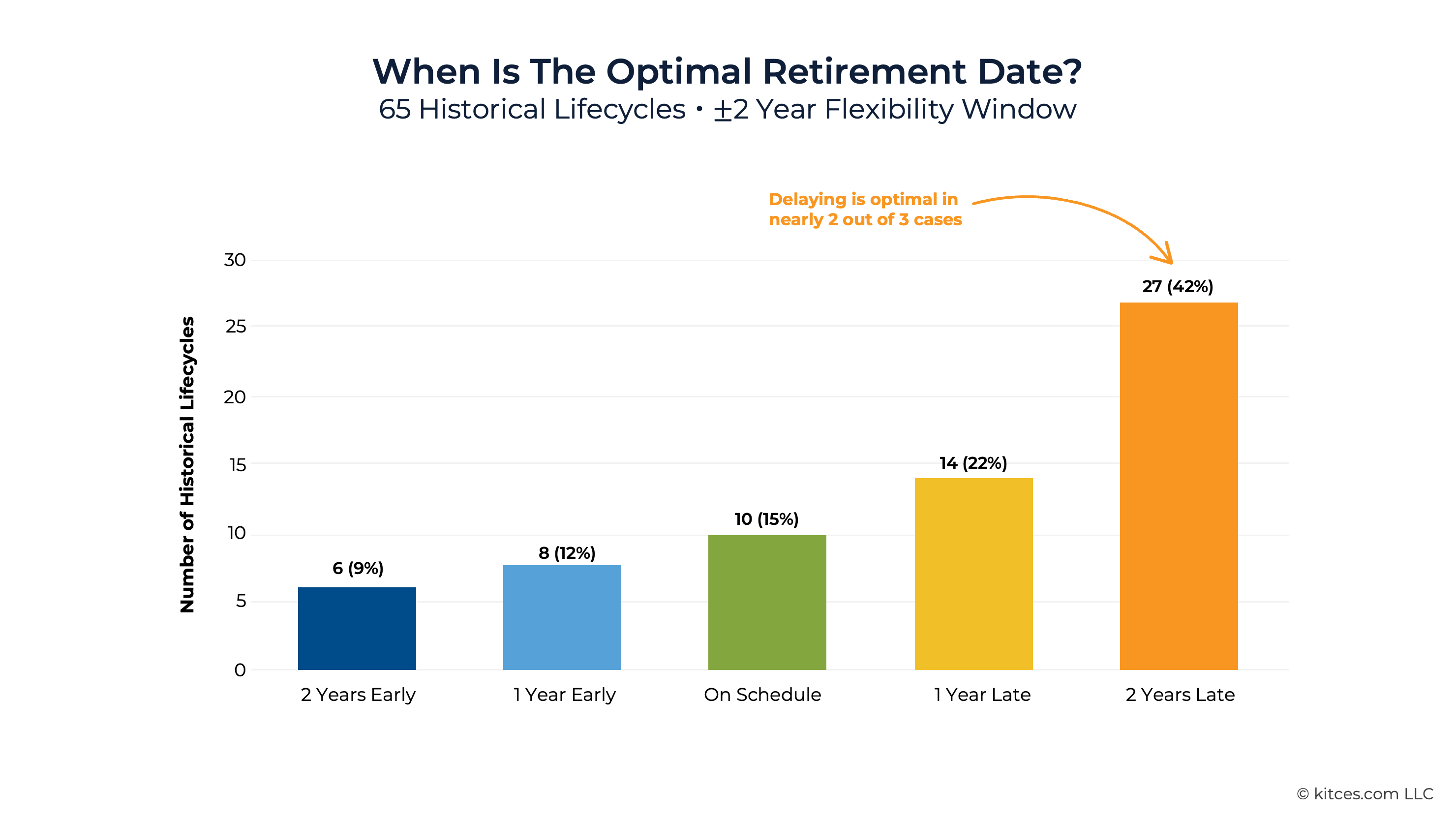
On this visitor submit, Georgios Argyris, Analysis Director at bellavia.app, explains how even a small shift in retirement timing can change the market setting the retiree enters and, with it, the sustainability of the plan. The impact turns into clear when evaluating in any other case similar retirees who start withdrawals in several environments. Throughout the historic lifecycle cohorts examined, permitting for a two-year flexibility window produced a median hole of roughly two-thirds in remaining portfolio worth between the most effective and worst timing selection inside the window. Retiring on the initially deliberate date was optimum solely about 15% of the time; typically the place a unique selection helped, delaying retirement produced a greater consequence.
This end result will be understood by separating retirement timing danger into two parts: cohort danger, which displays the general return setting a retiree experiences, and pure sequence danger, which displays the order of returns inside that setting. Historic evaluation means that roughly three-quarters of retirement consequence variability is pushed by cohort danger, whereas solely about one-quarter is attributable to return ordering inside a cohort. This distinction issues as a result of most conventional planning instruments – together with dynamic withdrawal methods, guardrails, and allocation changes – function solely inside a given cohort, subsequently addressing solely the smaller portion of danger. Against this, adjusting the retirement date is likely one of the few levers that may shift a shopper into a unique cohort altogether.
This framework additionally results in a counterintuitive perception: purchasers who seem most ready for retirement – typically these with the most important portfolios after robust accumulation durations – should face elevated timing danger. Sturdy bull markets can inflate retirement balances whereas leaving purchasers uncovered to weaker ahead returns. Because of this, a big portfolio worth at retirement may not, by itself, point out that the timing is favorable. Advisors can partially assess this danger utilizing valuation metrics such because the Shiller CAPE ratio, which has proven a relationship with subsequent decade-long returns and may also help determine whether or not present circumstances resemble traditionally unfavorable retirement environments.
Finally, the important thing level is that retirement timing could deserve a bigger position in retirement planning than it’s typically given. Advisors could enhance outcomes by first contemplating whether or not the retirement date itself ought to be adjusted, significantly when market circumstances seem unfavorable. When timing flexibility is proscribed, lowering the preliminary withdrawal charge can present a margin of security, whereas dynamic spending methods may also help handle the remaining ordering danger. By recognizing retirement timing as a planning variable relatively than merely a hard and fast assumption, advisors can higher place purchasers to navigate uncertainty and help the sustainability of retirement revenue over time.