


After suspected North Korean hackers exploited crypto alternate Bitget for $387.5 million final week, investigators have been in a position to rapidly flag and hint the recipient addresses.
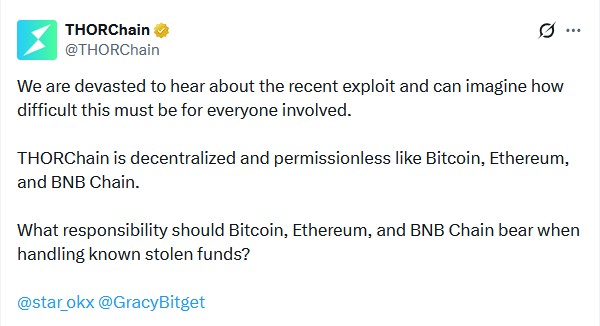
Bitget CEO Gracy Chen then controversially demanded that decentralized cross-chain swaps platform THORChain “refuse service to those addresses.”
THORChain responded:
“THORChain is decentralized and permissionless like Bitcoin, Ethereum, and BNB Chain. What duty ought to Bitcoin, Ethereum, and BNB Chain bear when dealing with identified stolen funds?”
The transfer was controversial, particularly given the protocol was halted instantly in Might when $10.7 million of its personal funds have been exploited. Complicating issues, THORChain has retired its admin key and doesn’t have a simple option to censor addresses, even when it needed to.
Supply: THORChain
This actual controversy has come up earlier than, as THORChain was used to swap round $1.2 billion of the funds stolen within the $1.46 billion hack of Bybit. It simply so occurred that THORChain’s admin key had been retired simply 11 days earlier.
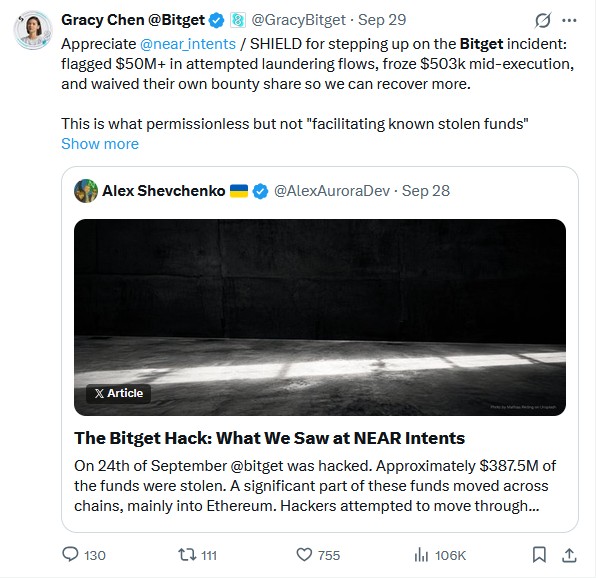
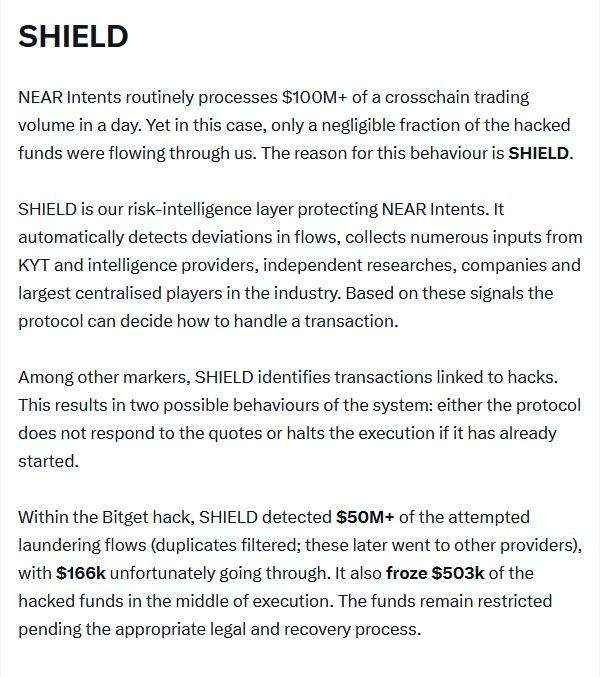
NEAR Intents took the alternative method to THORChain. Its automated SHIELD program blocked addresses linked to the hack from swapping $50 million on the platform, and even turned down the 5% bounty Bitget was providing for doing so.
Now NEAR Intents is beneath hearth from decentralization maxis for not being permissionless sufficient.
To debate the authorized points concerned within the case, Journal spoke with Yuriy Brisov from D&A Companions. That is an edited model of the dialog.
Journal: Bitget requested THORChain to dam funds tied to the hack, and it responded saying it’s decentralized and permissionless. Is {that a} authorized protection? Have they got an obligation to dam these addresses?
Brisov: It relies on the extent of decentralization. So once they do that — once they block some addresses — they present that their nodes aren’t really decentralized. It’s good for the group, once they can use this energy to forestall some malicious actions. Nonetheless, on the identical time, they open themselves to another authorized declare. Their solely safety is “we’re decentralized.”
Within the Uniswap case, they mentioned ‘we’re really decentralized and there’s nothing we are able to do.’ [Investors sued Uniswap after buying 38 rugpull and scam tokens, but a judge dismissed the case in March —Ed.]
And that is the strongest protection for any DeFi protocol. In the event that they present that they will block, management, or one way or the other intrude — even in a superb religion try to forestall fraud — they nonetheless open themselves for these sorts of claims. That you probably have management, then possibly your management shouldn’t be restricted to solely apparent fraud circumstances. You need to indicate [control over] due diligence issues. You need to apply KYC and AML protecting measures.
Associated: Uniswap beats class motion alleging it assisted crypto ‘rug pulls’
Journal: NEAR Intents blocked these addresses, and Bitget thanked them for doing so. Does that imply NEAR has proven Intents is just not decentralized and can due to this fact must intrude in plenty of different conditions?
In case you present that you’ve management over belongings, then you definately probably open your self to all potential claims concerning pump-and-dump schemes, volatility, or another potential claims of any traders who one way or the other have been broken and harmed. They usually can now say that you’ve management. Why do you utilize it in a single case and never use it in one other case? Why don’t you test all of your token issuers in your platform? Why don’t they supply KYC varieties like on any centralized alternate?
Supply: Gracy Chen
Journal: THORChain argues the protocol halt in Might initially triggered by an automatic system and that they don’t have the flexibility to dam sure addresses. If true, is {that a} protection?
Brisov: It is likely to be. We don’t know but, as a result of it hasn’t been challenged but. However any quantity of management makes any DeFi mission weaker vis-à-vis any claimant.
Journal: Alternatively, the protocol may improve the software program if it wished to dam sure addresses. May a mission get in authorized hassle for being reckless or negligent in the event that they don’t impose one thing like that?
It relies on the way it’s been accomplished from the technical facet. Say there’s an oracle that may detect any North Korean IP and block it mechanically, and there’s no one who sits and presses a button — “there’s a North Korean hacker, let’s block him.” Then it’s okay.
If there’s a workforce that oversees the scenario and says, “Okay, we are able to see that is a bootleg exercise, we block these addresses, we press the button manually.” From the authorized viewpoint, although it’s a superb act and it advantages the group, it nonetheless makes the mission not absolutely decentralized from the authorized perspective, and it strips you of the safety that laws like MiCA [EU’s Markets in Crypto Assets laws] or the overall understanding the SEC and CFTC present that if you happen to’re absolutely decentralized, you can’t be responsible for the actions of the individuals in your ecosystem.
Supply: Alex Shevchenko
Journal: NEAR’s expertise known as SHIELD and it’s an automatic course of that identifies addresses related to identified hacks on public blockchains after which blocks them from accessing Intents mechanically. Does that imply it’s extra prone to be seen as decentralized?
Brisov: Undoubtedly. They present that they’re good-faith actors attempting to [add] protecting measures into their protocols. There isn’t a compliance workforce, individuals who sit there and management the operation manually. It is a sensible answer, and that’s what we advocate to all of the DeFi firms.
Journal: In February 2025, THORChain retired the admin key which might enable them to make these kinds of unilateral modifications. With the dearth of an admin key and the actual fact they’ve obtained 100 validators, does that make them sufficiently decentralized?
Brisov: Extra probably than not, however we are able to’t say that for certain. I might say sure.
Journal: THORChain is just not a mixer. You may take stolen Bitget funds and swap them on THORChain, however when it comes out the opposite finish, it can nonetheless be transparently linked to the Bitget hackers. How does that match the definition of cash laundering? Or is it receiving stolen items?
Brisov: I don’t see how they are often responsible for cash laundering as a result of even Twister Money, that was, to a sure extent, made to launder cash [avoided US sanctions as immutable smart contracts are not sanctionable property in terms of money laundering—Ed].
American regulation treats one thing as both property or not property. And cash laundering is illegally shifting property by the authorized channels. You make proceeds of illicit exercise, and it’s property, and then you definately transfer it by some channels and attempt to make it authorized. However sensible contracts usually are not property in any respect. You don’t management them. You don’t personal them. That’s how Twister Money gained their case in court docket vis-à-vis OFAC sanctions. They only proved that they don’t have any management over their sensible contracts.
Journal: The Bybit hack occurred 18 months in the past. Does that imply that no authorized motion goes to be taken in opposition to THORChain, or do these circumstances simply take a very long time?
Brisov: It would occur sooner or later, undoubtedly. After the Bybit case, they severely opened themselves for potential claims.
Journal: Massive Questions: Does Satoshi really personal 1.1 million Bitcoin?
Cointelegraph publishes long-form journalism, evaluation and narrative reporting produced by Cointelegraph’s in-house editorial workforce with subject-matter experience. All articles are edited and reviewed by Cointelegraph editors according to our editorial requirements. Some articles include affiliate hyperlinks, from which Cointelegraph could earn a fee. These relationships don’t affect which merchandise we evaluate or our editorial conclusions. Content material printed in right here doesn’t represent monetary, authorized or funding recommendation. Readers ought to conduct their very own analysis and seek the advice of certified professionals the place applicable. Cointelegraph maintains full editorial independence.