

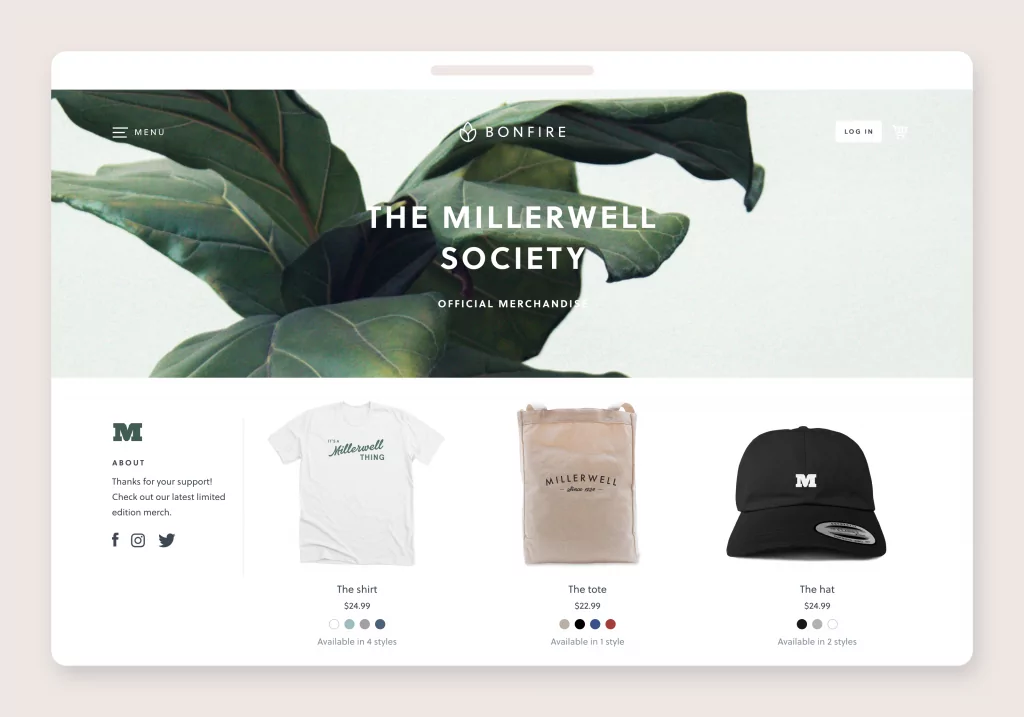

Excited by promoting merchandise to help your nonprofit’s mission? This fundraising methodology is authorized for tax-exempt organizations, so long as you comply with related tax pointers.
To ascertain a dependable income stream, present supporters with an intuitive and handy technique to buy your merchandise on-line. Conventional e-commerce platforms typically lack options tailor-made to nonprofits and may create extra administrative work in your workers, together with stock administration and delivery.
On this information, we’ll reply your questions on nonprofit ecommerce and take a deep dive into the highest ecommerce platforms to assist you decide:
Can nonprofits legally promote merchandise?
Sure, nonprofits can legally promote merchandise, supplied the merchandise are instantly associated to your mission or mission-aligned objectives. Moreover, your nonprofit does want to pay attention to particular tax guidelines:
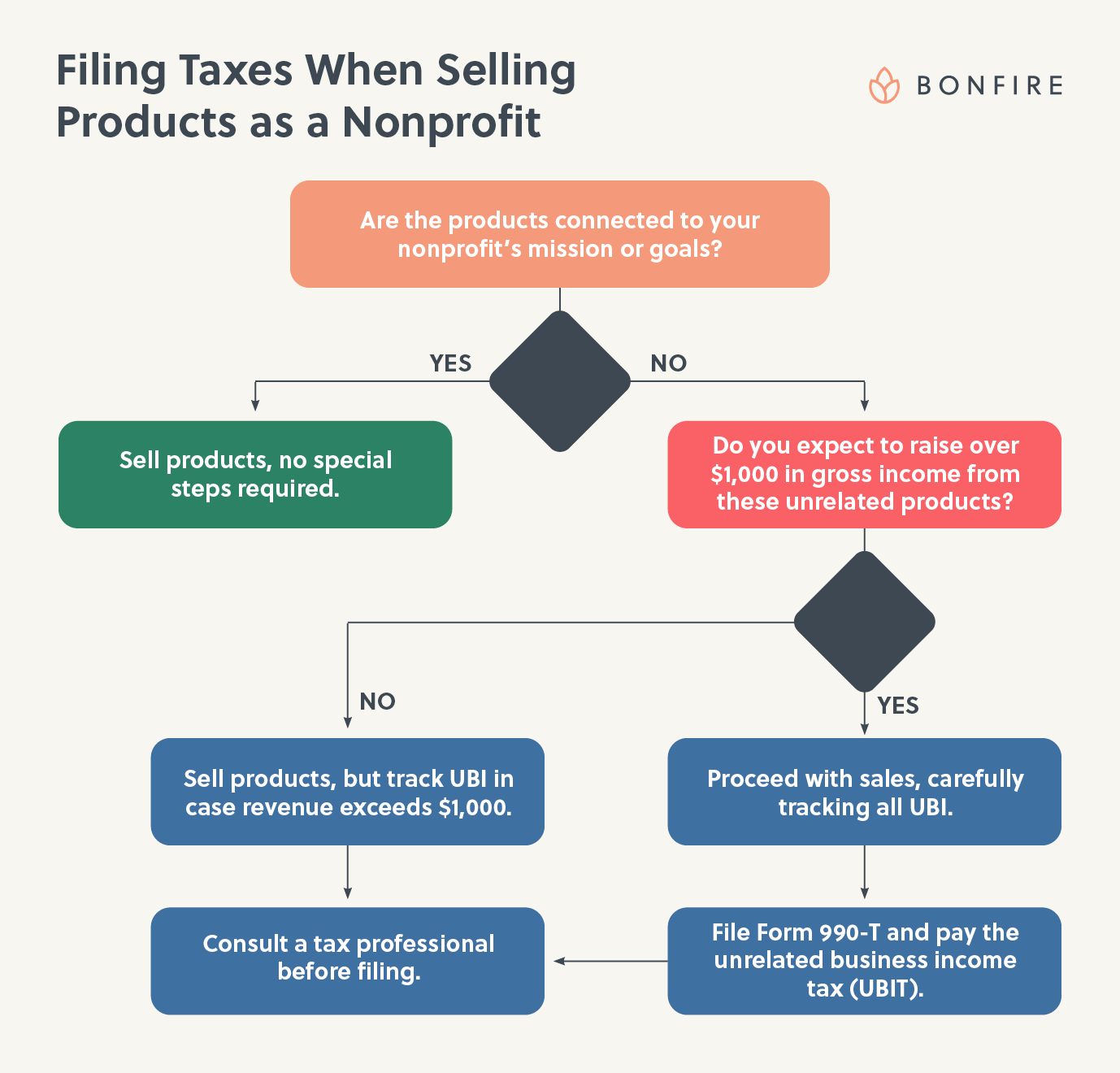
- Unrelated Enterprise Earnings Tax (UBIT) rules: This tax usually applies to nonprofits that promote merchandise that should not considerably associated to their mission. In these circumstances, the IRS would possibly require you to pay taxes on these particular earnings. Search steering from an authorized tax skilled to find out whether or not your nonprofit will probably be topic to those taxes and to make sure full compliance.
- Type 990-T: In case your nonprofit raises over $1,000 in gross revenue by promoting merchandise unrelated to your mission, you should additionally file a Type 990-T to stay compliant, totally clear, and tax-exempt.
The next flowchart may also help you identify whether or not these guidelines apply to your nonprofit, however we additionally suggest working with an expert to make clear any factors of confusion:
Guaranteeing the objects you promote are mission-aligned is essential for maximizing income and retaining your nonprofit’s tax-exempt standing. Printing your brand on attire, weaving instructional messaging instantly into your product designs, or selecting objects with performance that helps your mission strengthens the argument that the objects are basically tied to your exempt goal.
For instance, a pores and skin most cancers consciousness group would possibly design customized hats and UV-protection solar shirts.
What are the advantages of promoting customized merchandise?
Nonprofit ecommerce gives a dependable stream of unrestricted funds that your nonprofit can use for its most pressing wants. Nonprofit ecommerce presents advantages like:
- Predictable revenue: These campaigns assist you to shift away from episodic, high-stress fundraising occasions and cease relying solely on aggressive funding sources like grants. Moreover, constant funding allows you to forecast annual budgets extra precisely and plan confidently for the longer term.
- Securing free offline promoting: Every time a supporter wears a branded t-shirt, they grow to be a strolling billboard in your mission. This natural visibility introduces your group to completely new native networks, producing consciousness with out costing a single dime in advert spend.
- Excessive donor participation: Your neighborhood genuinely desires to help your group by buying merchandise that help your mission. 45% of donors often buy from a web-based retailer that helps a nonprofit, underscoring how tangible items present an instantaneous sense of reward for his or her monetary contribution.
Steps to Launch Your Nonprofit Ecommerce Marketing campaign
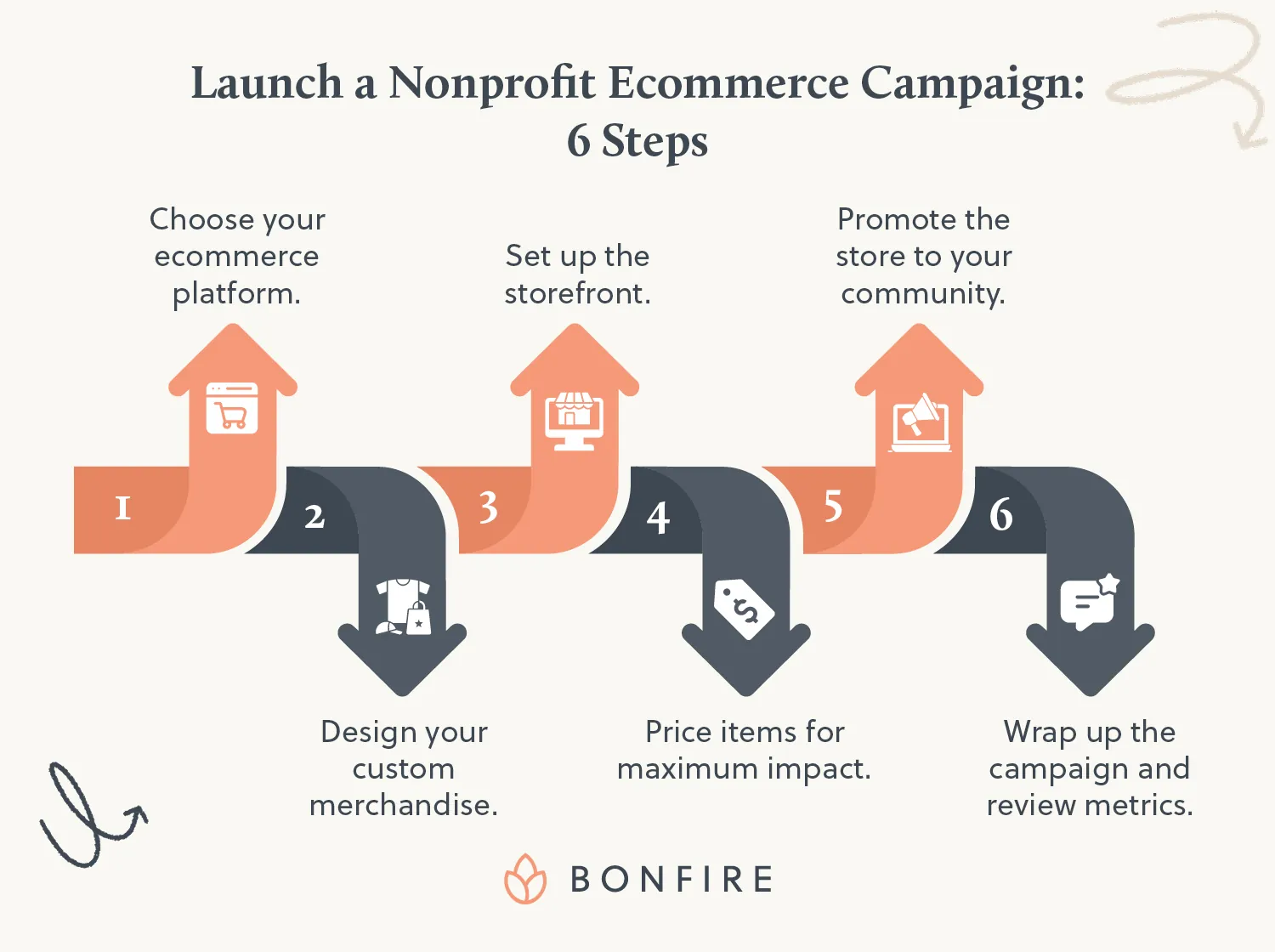
1. Select your ecommerce platform.
Begin with an answer that prioritizes simplicity and nonprofit-focused performance over advanced options your group might not even want. Whereas widespread platforms typically provide intensive customization, they’ll require technical abilities and ongoing upkeep that your workforce doesn’t have the time or experience to deal with.
That will help you determine, we’ve put collectively a comparability of the most well-liked platforms for nonprofit ecommerce:
| WooCommerce | Shopify | Bonfire | |
|---|---|---|---|
| Value | The core plugin is free, however internet hosting ($25-$350 per thirty days) and extensions ($29-$299 per yr) price further. | Fundamental plans begin at $29 per thirty days. | 100% free platform with no month-to-month charges. |
| Developer wanted? | Not all the time, however builders are wanted for customized performance, integrations, themes, and PCI compliance. | No, however there could also be a steep studying curve for organising and optimizing the shop. | No. Establishing a marketing campaign and retailer is fast and simple for anybody. |
| Stock administration | Guide for updating new shipments or syncing stock, however robotically updates inventory in response to on-line purchases. | Computerized stock degree monitoring, with some guide workflows (except built-in with third-party apps). | Zero stock administration, as merchandise are printed on demand. |
| Achievement & logistics | Organizations deal with all delivery and logistics. | Organizations deal with all delivery and logistics. | Bonfire handles every part, together with printing, delivery, and customer support. |
| Nonprofit-specific instruments | Requires constructing customized options or leveraging specialised plugins. | Requires integrating third-party apps. | Provides varied nonprofit options, together with built-in CSV donor downloads, lowered charges, donation assortment, and integrations with suppliers like GoFundMe. |
WooCommerce
The WooCommerce plugin permits customers to create a customizable, open-source ecommerce retailer on a WordPress web site. Whereas the plugin offers you whole management over your digital storefront, it comes with heavy technical obligations, reminiscent of:
- Buying a separate server internet hosting.
- Putting in the core open-source WordPress CMS (if you happen to haven’t already).
- Configuring the WooCommerce plugin framework, which entails organising the underlying digital engine so your retailer is quick, safe, robotically calculates taxes and delivery, and connects seamlessly to your donor databases.
Moreover, your inner workforce or a employed developer is solely answerable for the positioning’s safety and upkeep. Usually, this implies managing SSL certificates for PCI compliance, repeatedly updating plugins to mitigate vulnerabilities, and manually configuring API keys for cost gateways reminiscent of Stripe or PayPal. This could create a big administrative burden for small organizations in search of a easy technique to enhance funding.
Shopify
Shopify is a well-liked software-as-a-service (SaaS) answer designed primarily for conventional retail companies. It gives a cultured storefront out of the field, however the platform might require expensive workarounds to suit nonprofit and print-on-demand needs.
While Shopify does automatically handle website hosting and credit card security, it still requires some technical setup. You will need to link your organization’s website address to Shopify and use their template tools to build the store. If your nonprofit needs the store to automatically send data to your donor tracking system, the built-in tools usually aren’t enough—in this case, you will need help from a programmer.
Because Shopify is designed for regular retail rather than nonprofits, it doesn’t include features for collecting donations. This means you will need to install separate apps and ensure they integrate with your full tech stack. Additionally, many of these apps charge monthly fees on top of what you pay for Shopify.
Bonfire
Bonfire is a specialized fundraising platform that allows nonprofits, individuals, schools, and other organizations to create and sell custom products, such as t-shirts, drinkware, and home goods. It offers completely free storefronts that your organization can quickly customize with its branding and messaging, making it easy to sell your products to supporters. Check out this quick video overview to see how setting up an apparel campaign works:
Moreover, with Bonfire, you may arrange your on-line retailer in simply three steps:
- Arrange your Bonfire account.
- Click on “Create My Retailer” or the “My Retailer” tab on the dashboard.
- Customise your retailer along with your group’s title, branding, and story. You’ll be able to change these particulars at any time, with no coding required.
Then, you’re prepared so as to add your merch campaigns—no sophisticated server internet hosting setup or plugin administration required. All you need to do is log in and begin constructing your retailer.
Moreover, when you design your merchandise and launch the marketing campaign, our workforce will deal with the remaining. Our system robotically processes funds, and we oversee printing, delivery, and customer support. And since Bonfire makes use of a print-on-demand mannequin, you’re not required to order merchandise forward of time. Every little thing features seamlessly within the background, releasing up your workers to focus solely on advertising the marketing campaign.
2. Design your customized merchandise
Creating interesting merchandise entails balancing your nonprofit’s mission and visible id along with your neighborhood’s preferences and on a regular basis usability. In different phrases, your objective is to design merch individuals truly need to use whereas staying true to your core mission.
Take into account the following tips when designing your customized merch:
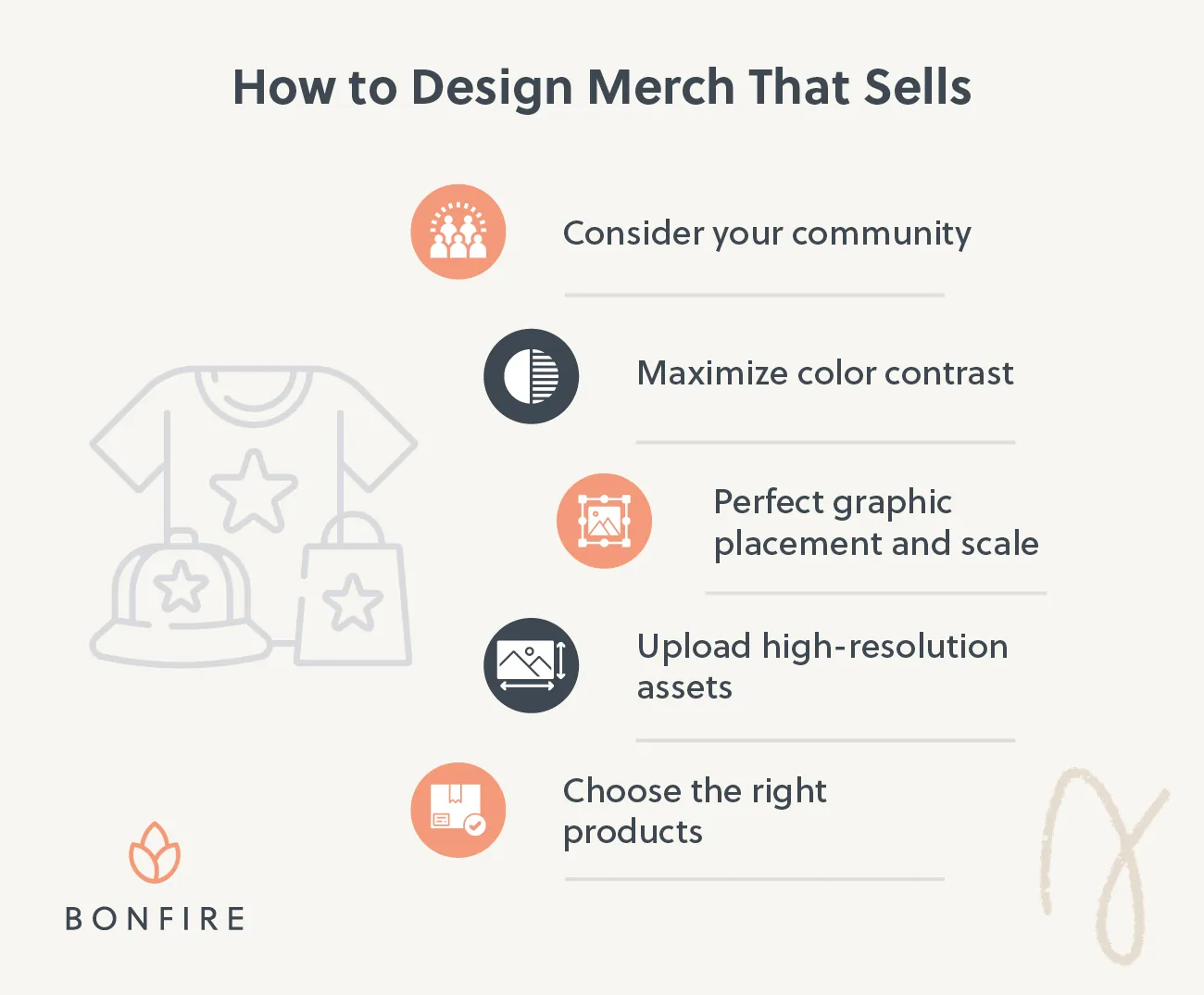
- Take into account your neighborhood: Your neighborhood might have already got an affinity for a sure design or program, and could be excited to buy merchandise that includes it. For instance, a zoo would possibly create a t-shirt design that includes fan-favorite animals like elephants, pandas, or sea otters.
- Maximize shade distinction: Make sure the colours you select in your printed design pop towards the merchandise’s supplies. Excessive shade distinction ensures your paintings is well readable from a distance and prevents your message from getting misplaced towards an identical shirt background.
- Excellent graphic placement and scale: For normal t-shirts, middle entrance designs and place them roughly two to 3 inches beneath the neckline, protecting the graphics a minimum of an inch away from seams. Sizing the paintings appropriately prevents the garment from feeling heavy and uncomfortable when worn.
- Add high-resolution belongings: In the event you’ll be importing your nonprofit’s brand or paintings, guarantee it’s in a vector or high-resolution format for clear, crisp print high quality. Pixelated graphics look unprofessional, whereas crisp vectors guarantee your merchandise displays your requirements.
- Select the suitable merchandise: Choose high-quality, comfy attire choices that your supporters will attain for. Give attention to premium materials to make sure your merchandise leads to supporters’ heavy rotation fairly than on the backside of a drawer.
3. Arrange the storefront
Subsequent, take the time to customise your storefront from a supporter’s perspective. Your storefront is the digital face of your marketing campaign, and it wants to obviously talk your mission and look skilled to construct belief.
You’ll be able to obtain this by:
- Writing a compelling retailer description that clearly states your mission so patrons know precisely who and what their buy will help.
- Customizing the visible branding through the use of your official brand and model colours.
- Explaining the tangible affect by detailing what particular buy quantities fund (e.g., “One hoodie gives three meals”).
- Enabling a donation possibility at checkout so passionate supporters can simply contribute further funds.
4. Value objects for optimum affect
Subsequent, develop strategic pricing that balances compelling design and affordability with wholesome revenue margins. Platforms like Bonfire make this simple by offering default beneficial costs optimized to strike the perfect stability.
Nonetheless, your group can nonetheless tailor costs as wanted to align along with your neighborhood’s preferences and fundraising objectives by:
- Minimizing base prices by protecting your designs easy, as decreasing ink colours and print areas lowers bills.
- Adjusting the retail value to match your particular neighborhood—for example, scaling it up or down from the default suggestion primarily based on what your donors are comfy paying.
- Leaving room for extra checkout donations by protecting base attire costs cheap.
5. Promote the shop to your neighborhood
Ending your designs, organising your storefront, and launching your first marketing campaign are all vital accomplishments. However your digital storefront received’t generate income just by current. You’ll must actively promote your ecommerce marketing campaign to maximise attain and hit your fundraising objectives.
Comply with these steps to advertise your marketing campaign to supporters:
- Map out a promotional calendar. Take into account scheduling your messaging round key marketing campaign milestones reminiscent of launch day, the midway mark, and the ultimate countdown to the marketing campaign deadline to keep up constant momentum.
- Interact loyal supporters early. Attain out to your most passionate donors and volunteers to make the primary purchases and share the shop hyperlink with their private networks.
- Get inventive with social media messaging. Keep away from sounding repetitive by alternating the messaging and formatting of your posts. As an illustration, you would possibly spotlight the design by sharing photos of your workers modeling the attire, present the real-world affect of the funds by spotlighting beneficiary tales, and create a way of urgency with a marketing campaign countdown.
- Centralize your storefront hyperlinks with a link-in-bio device in your social media profiles, making it handy for followers throughout varied platforms to seek out your store.
- Leverage your current e-mail listing to ship focused, visually interesting emails that announce the brand new merchandise, clarify the trigger it helps, and drive clicks to your retailer.
Moreover, keep in mind to observe marketing campaign engagement metrics and gross sales as you go. See which platforms or merchandise kinds are performing greatest, and alter your promotional technique to lean into what works.
6. Wrap up the marketing campaign and overview metrics
As soon as your marketing campaign ends, comply with up with supporters to foster long-term belief. Rejoice the collective affect your neighborhood made by sharing the ultimate quantity raised, highlighting the variety of objects offered, and stating the way you’ll use the funds. Moreover, ship a devoted thank-you e-mail to every supporter to speak your gratitude.
Internally, use this time to research your marketing campaign’s efficiency. Evaluation which kinds and designs generated essentially the most income, determine which promotional channels had the best conversion charges, and calculate your closing revenue. By analyzing these key information factors, your workforce will know what works and what doesn’t, serving to you refine your technique for subsequent time.
Ideas for Success in Nonprofit Ecommerce
Seeking to take your subsequent marketing campaign up a notch? Incorporate the next tricks to broaden your attain and earn extra in your trigger:
- Select seasonal merchandise: Choose objects that match the season you’re promoting in. As an illustration, you would possibly promote hoodies within the winter and light-weight tees for summer season occasions.
- Supply limited-time drops: Domesticate a way of urgency by providing particular shirt designs for less than a brief window earlier than retiring them. These deadlines assist nudge extra hesitant patrons to decide.
- Leverage peer-to-peer sharing: Empower board members, volunteers, and different prime advocates to share the shop hyperlink on their private social media profiles to faucet into their networks. This easy motion can introduce your mission to tons of of potential new donors.
- Align merch with broader campaigns or initiatives: Tie particular t-shirt designs to imminent consciousness months, giving days, or annual fundraising galas to create cohesive advertising pushes. Merch ought to complement your current calendar, not compete towards it.
Launch your risk-free on-line retailer
Launching a web-based retailer shouldn’t power your nonprofit workforce to grow to be specialists in design, know-how, or advanced logistics. Through the use of a zero-risk, print-on-demand platform like Bonfire, you may safe predictable income and switch supporters into advocates in your trigger whereas focusing in your core mission. Get began right this moment by kicking off your Bonfire marketing campaign.
Further Assets
