



Ethereum’s Glamsterdam improve has gone dwell on the Sepolia testnet, in one of many ultimate main rehearsals earlier than its mainnet activation.
Glamsterdam went dwell on Sepolia on Tuesday at 1:53 pm UTC, Ethereum neighborhood contributor Pooja Ranjan introduced in an X publish.
The improve goals to advance Ethereum’s layer-1 scaling roadmap with enshrined proposer-builder separation, block-level entry lists and modifications to gasoline pricing that higher mirror the price of execution, the Ethereum Basis introduced in a Sept. 28 weblog publish.
The event marks one of many ultimate testnet launches for Glamsterdam, arguably one of many most consequential upgrades of 2026, aiming to make the Ethereum community extra scalable and environment friendly.
Following the testnet launch, builders will decide Glamsterdam’s activation date on the Hoodi testnet, earlier than figuring out the ultimate date of its mainnet launch.
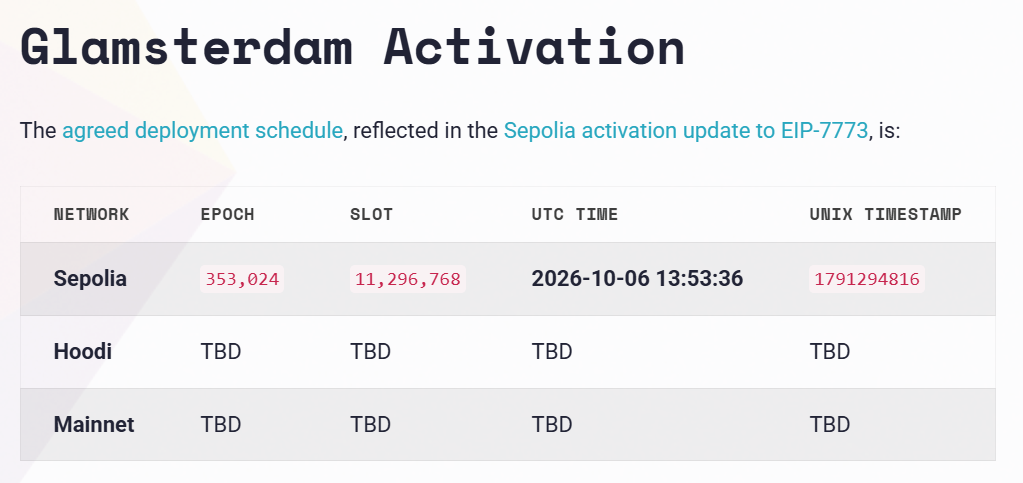
Glamsterdam activation schedule. Supply: Ethereum.org
Aiming to enhance Ethereum’s effectivity and scalability
Glamsterdam marks the following main improve after Fusaka, designed to enhance scalability, harden the layer-1 and make the community simpler to make use of.
The improve’s headliner modifications are enshrined proposer-builder separation (ePBS) and block-level entry lists (BALs), which change how blocks are produced and validated to assist higher throughput on the Ethereum mainnet.
Enshrined Proposer-Builder Separation, or EIP-7732, introduces separation between block proposers and builders on Ethereum’s consensus protocol, whereas additionally separating consensus validation from execution validation, giving validators extra time to validate execution payloads.
At present, Ethereum is operating in single-lane mode, processing transactions in a single order. Parallel processing seeks to allow larger transactions per second on Ethereum and greater block sizes, with out elevating the gasoline restrict.
Associated: Ethereum Institutional indicators assist for Ethlabs’ movement to cut back Ethereum block instances
The second headliner change, EIP-7928, introduces enforced block-level entry lists that report accounts and storage areas accessed throughout a block, together with post-transaction state modifications. These lists allow shoppers to learn state from disk in parallel, validate transactions in parallel and compute state roots extra effectively.
In a Might weblog publish, the Ethereum Basis stated it established a 200 million gasoline restrict ground for Glamsterdam, giving the community a serious post-upgrade pace enhance from its present gasoline restrict of round 60 million.
Following Glamsterdam’s mainnet activation, Ethereum builders will start implementing Hegotá as the following main improve. In August, Ethereum builders began reviewing 66 proposals to slim them down as a part of scoping Hegotá, with a number of proposals geared toward bringing extra privateness capabilities into the protocol.
Journal: Why Ethereum builders need ‘one-click staking’ for establishments