


On this version of the reader story, we now have a private monetary audit in three components. (1) A reader’s investing journey and the way his pondering advanced, (2) a factual audit of his present monetary place, and (3) how he’s approaching the street forward.
Opinions expressed in reader tales don’t essentially symbolize the views of freefincal or its editors. We should recognize a number of options to the cash administration puzzle and empathise with numerous views. Articles are usually not checked for grammar until it’s essential to convey the correct that means and protect the tone and feelings of the writers.
If you need to contribute to the DIY group on this method, ship your audits to freefincal AT Gmail dot com. You may publish them anonymously if you want.
My publicity to markets started by chance round 2010–11, after I was nonetheless in my ultimate 12 months of commencement. At the moment, my tv habits had been easy—cartoons and information. Someday, whereas browsing channels, I landed on a enterprise information channel airing a inventory market present.
There was an anchor, a visitor launched as a market knowledgeable, and callers searching for recommendation. The knowledgeable was confidently telling callers which shares to purchase, which to promote, and which to carry. He spoke with certainty and authority. I used to be in awe. I keep in mind pondering, persons are being advised precisely learn how to earn a living.
I began watching that present often. It turned my favorite program on tv. I genuinely believed that these specialists knew what they had been doing and that, sometime, I too may gain advantage from this “data”.
My household, particularly my mom, was uncomfortable with this. She would inform me to not watch this “satta bazaar”—a playing den, as she noticed it. In accordance with her, the inventory market was not meant for individuals like us. I brushed this off. I assumed she merely didn’t perceive trendy investing.
Then someday, one thing occurred that stayed with me.
A caller requested for recommendation on a inventory that was in loss. The knowledgeable calmly recommended promoting it. The caller responded angrily: “It was you who advised me to purchase this inventory on this very present. Now that it’s not performing, you’re telling me to promote?” The knowledgeable replied that the inventory may nonetheless do effectively if held for one or two years.
That alternate hit me onerous.
Till then, I had believed that specialists had readability, if not certainty. That second made me realise that recommendation may change, narratives may shift, and accountability was lacking. At that very second, I advised myself one thing fairly excessive: I’ll by no means purchase a inventory immediately. To today, I should not have a demat account.
Quickly after, I found related exhibits targeted on mutual funds. The format was similar—anchor, knowledgeable, callers—however mutual funds felt safer, extra respectable, and extra appropriate for somebody like me. These exhibits talked endlessly about returns, and that turned the one factor that caught with me. Mutual funds, I believed, had been a wiser, extra mature model of inventory investing.
I graduated in 2012 and began working in 2013. I needed to put money into mutual funds, however I had no thought how. In 2014, a buddy advised me to carry a clean cheque and copies of my PAN and Aadhaar. He took me to an individual who, he stated, would “do every little thing”.
I requested a fundamental query: Which mutual fund ought to I put money into?
The reply was easy: a small-cap fund and an infrastructure fund—as a result of they had been giving good returns.
That was sufficient for me.
Over the subsequent 5 years, I skilled my first actual investing feelings. The small-cap fund would rise sharply, then fall simply as sharply. When it went up, I felt good. When it went down, I felt anxious. The infrastructure fund barely moved and delivered low, single-digit returns. I didn’t perceive why. I didn’t know why one fund was unstable, and one other was stagnant. Nonetheless, I felt some satisfaction that I used to be a minimum of “investing”.
As my earnings elevated, I added extra funds—an ELSS fund and a mid-cap fund in 2018—once more based mostly on knowledgeable suggestions from tv and YouTube. Virtually instantly after beginning these SIPs, returns started to fall.
Watching NAVs go down day after day was deeply unsettling. I didn’t know what was flawed. I didn’t know whether or not this was regular. I saved telling myself to be affected person, however inside I used to be pissed off and confused.
What angered me probably the most was seeing the identical specialists who had really helpful these funds later advising others on tv to promote them. When callers confronted them—simply as that inventory investor had years earlier—the solutions had been imprecise: you’ll be able to promote, you’ll be able to maintain, you’ll be able to swap. None of it helped me resolve what I ought to do. In the meantime, bills had been being charged no matter efficiency.
That frustration pushed me to study by myself. I found TERs, the excellence between common and direct plans, and the function of mutual fund distributors. I realised that each one my investments had been in common plans and that I used to be paying larger prices with out receiving any actual steering. I felt cheated—extra by my very own ignorance than by anybody else.
I finished investing via distributors and began SIPs immediately in two large-cap funds and one multi-cap fund. I felt relieved—lastly, I used to be “doing it myself”.
However this solely added to the confusion. I now have seven funds throughout classes: small-cap, infrastructure, ELSS, mid-cap, large-cap, and multi-cap. Regardless of investing for years, my feelings had been nonetheless tied to short-term returns. A couple of months of unfavorable efficiency would trouble me disproportionately. I nonetheless had no actual understanding of asset allocation or long-term threat.
Index funds had been talked about sometimes, however nearly at all times dismissed as inferior—one thing for inexperienced persons or individuals keen to accept decrease returns. I absorbed that messaging and stayed away from them.
Every part got here to a head in 2020.
In the course of the COVID crash, my complete portfolio turned purple. On the similar time, I began listening to about diversification formulation like 60–30–10 (flexi/massive–mid–small). For the primary time, diversification felt like a rule reasonably than a hope. This construction gave me consolation. I satisfied myself that if I simply chosen the best-performing lively funds in every class and maintained this ratio, I’d be secure.
I even determined that, beginning in 2021, I’d clear up my portfolio and implement this plan. I genuinely felt I had lastly figured issues out.
Round this time, I heard Subra say one thing that made me uncomfortable. He remarked that when he seems on tv, individuals ask what to do about fairness investments which have given unfavorable returns during the last six months. His response was blunt: equities are meant for many years, not months.
I realised with some embarrassment that I used to be precisely that individual.
I used to be calling myself a long-term investor, however emotionally reacting to each fall. That contradiction compelled me to cease and replicate. For the primary time, I began pondering significantly about retirement and long-term targets, reasonably than simply returns and recoveries.
Quickly after, I learn a private finance audit by Avadhoot Joshi on Freefincal, which led me to the Asan Concepts for Wealth (AIFW) group.
This modified every little thing.
The conversations there weren’t about beating the index or discovering the subsequent high fund. They had been about targets, asset allocation, threat, and—most significantly—behaviour. I realised that the majority of my stress through the years had come not from low returns, however from not having a framework I may emotionally stay with.
Index funds, which I had as soon as dismissed, now made sense. Not as a result of they promised larger returns, however as a result of they lowered decision-making, remorse, and self-doubt. They allowed me to remain invested with out always questioning myself.
My selection to stay with index funds will not be ideological. It’s private. I do know myself effectively sufficient to confess that I can’t persistently decide successful lively funds or keep on with them via lengthy intervals of underperformance. I’ve lived that cycle already.
My objective is straightforward: attain an outlined monetary goal in a given time-frame with as little emotional turmoil as potential. Index funds assist me try this. Others might select lively funds, and that’s completely advantageous.
This journey taught me one uncomfortable however liberating lesson: I alone am answerable for my monetary outcomes. Index funds are the instrument I’ve chosen, totally conscious of their limitations. I’ve chosen this path intentionally, and I don’t intend to return to lively funds.
PART 2: The Precise Private Finance Audit
Are the Fundamentals Coated?
One of many first questions repeatedly requested within the Asan Concepts for Wealth (AIFW) group by Ashal Jauhari is:
“Are the fundamentals lined?”
Earlier than discussing asset allocation, mutual funds, or returns, this query forces a verify on monetary survivability. Over time, I’ve realised that with out these fundamentals in place, any dialogue about investing stays fragile. Utilizing this framework, I’m itemizing my present monetary place under, with out trying to optimise or defend any selections.
- Time period Insurance coverage
- Present cowl: ₹2 crore time period insurance coverage from Max Life
(Initially ₹1 crore; elevated by a further ₹1 crore as earnings grew) - Revenue a number of lined: Roughly consistent with the generally recommended fundamental vary of 15–20× annual earnings
- Considerations/gaps:
Whereas the duvet broadly meets the fundamental guideline, it could nonetheless want reassessment over time, contemplating inflation, remaining working years, and future tasks.
- Well being Insurance coverage
- Private medical insurance:
- ₹10 lakh base coverage + ₹90 lakh tremendous top-up with Tata AIG
- Coverage taken via Neeraj Okay (AIFW reference)
- Employer medical insurance: ₹6 lakh
- Recognized exclusions or worries: None recognized as of now
This setup supplies excessive protection unbiased of employment and doesn’t rely solely on the employer coverage.
- Emergency Fund
- Common month-to-month bills: Equal of ~3 months
- Emergency corpus obtainable: Sure
- Months of bills lined: ~3 months
- Parking of funds:
- SBI MOD account
- Arbitrage fund
- A small SIP in a liquid fund began a couple of years in the past to partially handle the lack of buying energy
The present emergency fund supplies short-term consolation however doesn’t but meet the extra conservative 12-months-of-expenses guideline.
- Targets Recognized
- Retirement:
- Goal age: 60
- Years away: ~25 years
- Different main targets: None recognized at this stage
At current, retirement is the one clearly outlined long-term monetary objective.
Property, Asset Allocation, and Present Place
(December 2025 snapshot)
For consistency and long-term monitoring, the retirement corpus is outlined upfront as X, and progress is measured relative to this goal.
- Present progress: ~5.3% of the focused retirement corpus (X)
Absolute numbers are deliberately averted to maintain the deal with construction and progress reasonably than scale.
Progress towards the focused retirement corpus (X)
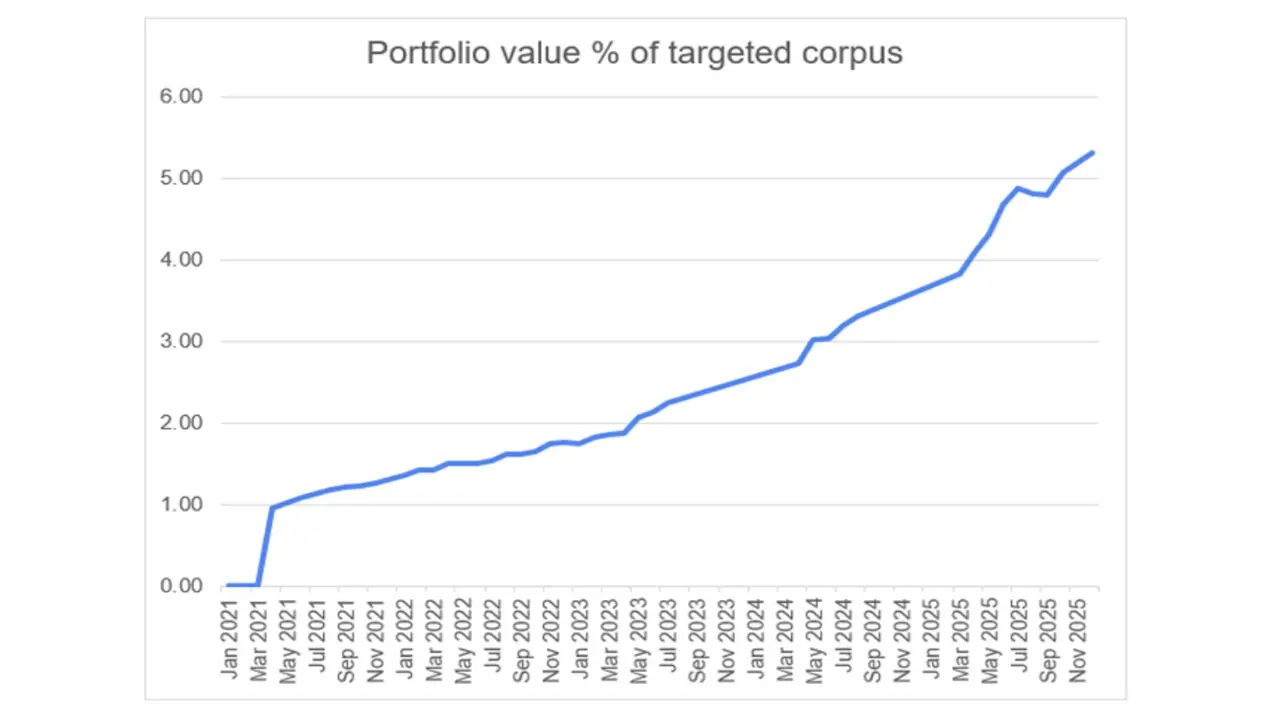
This chart tracks progress relative to the outlined retirement objective and is used solely as a directional indicator, not as a measure of short-term efficiency.
General Asset Allocation (%)
- Fairness: 60.48%
- Debt / Stability: 39.52%
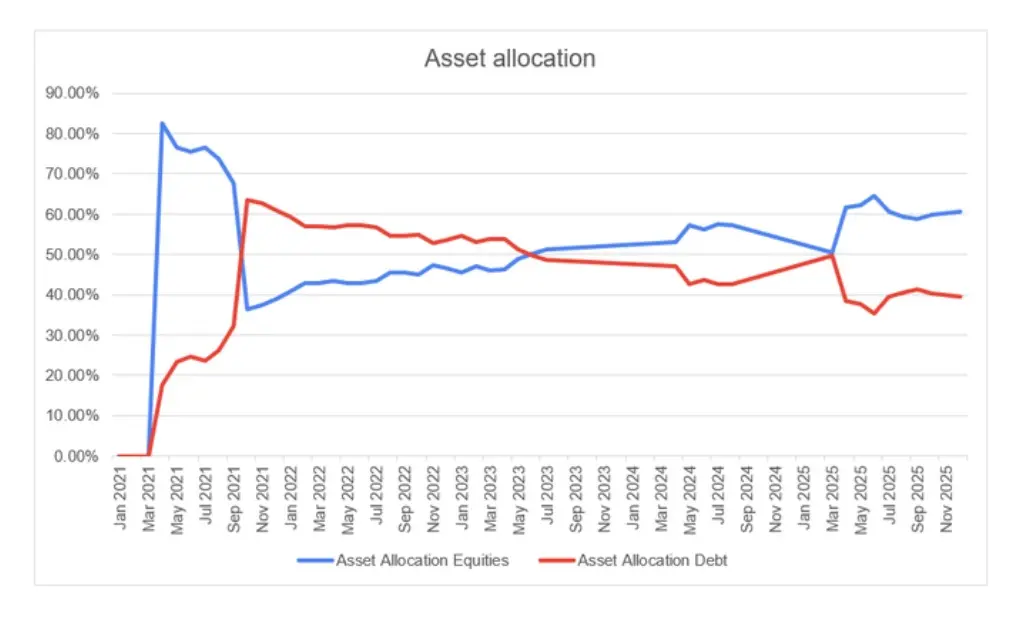
Fairness Allocation (% of Fairness)
- Nifty 50 Index Fund: 88.84%
- Different Fairness Mutual Funds: 4.70%
- NPS (Fairness element): 6.46%
The fairness portion is deliberately concentrated round a broad-market index.
The allocation to different fairness mutual funds represents legacy investments from an earlier part of my investing journey. Most of this publicity has already been withdrawn over time, with proceeds both reinvested or redeployed elsewhere. Going ahead, this allocation is predicted to cut back to zero, as no recent investments are deliberate in lively fairness funds.
Debt / Stability Allocation (% of Debt)
- EPF: 50.39%
- PPF: 11.79%
- NPS (Debt element): 37.18%
- Gold (SGB): 0.63%
Debt allocation is dominated by long-term, retirement-oriented devices, leading to comparatively low liquidity however excessive predictability.
Context on EPF, PPF, and NPS Contributions
The presence of EPF, PPF, and NPS within the portfolio is basically the results of earlier tax-driven selections, made earlier than I used to be launched to AIFW-style goal-based planning.
- PPF and NPS had been initially began primarily for tax financial savings underneath the outdated tax regime.
- With the transition to the brand new tax regime, I used to be successfully locked into these devices.
- Subsequently, my particular person NPS was transformed into a company NPS, and all superannuation advantages had been transferred to this account.
- Consequently, my employer now contributes to each EPF and NPS on an ongoing foundation.
- PPF contributions are at the moment saved at a minimal stage, primarily to maintain the account lively reasonably than as a core accumulation car.
This explains why a good portion of the debt allocation is concentrated in EPF and NPS, regardless that recent voluntary contributions are restricted.
Portfolio Allocation (% of Whole Portfolio)
- Nifty 50 Index Fund: 53.73%
- Different Fairness Mutual Funds: 2.84%
- EPF: 19.91%
- PPF: 4.66%
- NPS (Fairness + Debt mixed): 18.60%
- Gold (SGB): 0.25%
NPS is primarily used as a structural instrument to appropriate asset allocation at any time when the meant fairness–debt stability (60:40) will get disturbed. This strategy is predicated on an thought I got here throughout in a tweet by Swapnil Kendhe, the place NPS contributions are used flexibly to tilt the portfolio again towards the specified allocation reasonably than as a return-maximising instrument.
Liabilities
- Residence mortgage: No
- Different loans: No
There are at the moment no excellent liabilities.
Adjustments In the course of the Final Yr
Over the past 12 months, there was no main structural change within the portfolio.
Fairness publicity has elevated progressively and organically, primarily via ongoing investments reasonably than deliberate rebalancing or tactical selections. The general asset allocation framework and funding decisions have remained unchanged.
This stability displays a aware resolution to prioritise consistency over frequent changes.
Closing Observe
This audit captures my monetary place as of December 2025. The portfolio is deliberately easy, largely index-driven on the fairness aspect, and anchored by long-term retirement devices on the debt aspect. Whereas sure gaps stay—most notably the scale of the emergency fund—they’re recognized and acknowledged.
At this stage, the main focus is on behaviour, consistency, and survivability, not optimisation.
PART 3: The Highway Forward
How I Suppose Concerning the Subsequent Part
This ultimate part will not be about predictions or ensures. It displays how my pondering continues to evolve, based mostly on what I’ve already skilled and what I’m snug dwelling with over the long run.
- Emergency Fund: Consolation as a Lump Sum, Not a Method
I don’t take into consideration my emergency fund by way of “months of wage” or “months of bills”. As an alternative, I’m extra snug defining it as a lump-sum buffer that gives each sensible and psychological consolation.
Reasonably than chasing a formula-driven goal, my strategy is to construct a standalone emergency corpus that feels ample for surprising conditions. To assist this, I’ve began a SIP in a liquid fund earmarked particularly for this goal and to mitigate the lack of buying energy, as mentioned earlier.
This permits the emergency buffer to construct progressively and independently, with out forcing abrupt modifications or drawing from long-term investments.
- Index Funds: A Acutely aware and Ultimate Selection
My choice for index funds is a deliberate and settled selection, formed by expertise reasonably than comparability. I don’t intend to return to actively managed mutual funds.
Index funds enable me to stay invested with out fixed analysis, fund switching, or second-guessing. Going ahead, my fairness investments will more and more transfer towards broader market indices, comparable to:
- Nifty 100
- Nifty 500
- or a Nifty Whole Market index
The intent is to personal the market extra broadly reasonably than concentrating solely on the most important shares. As my portfolio reaches a sure measurement (X), I plan to cease incremental investments within the Nifty 50 and direct new fairness contributions towards a broader illustration of the Indian fairness market.
This transition will probably be gradual and pushed by portfolio scale, not market circumstances.
- Worldwide Fairness
At current, worldwide mutual fund investments are constrained resulting from regulatory limits. As soon as these limits are lifted, I want to discover allocating a portion of my fairness publicity to worldwide markets.
I’ve intentionally not fastened a share for this allocation. The choice will probably be taken when the choice turns into virtually obtainable, based mostly on simplicity of execution and general portfolio context at the moment.
- Asset Allocation and Rebalancing: Flexibility in Instruments
Presently, asset allocation corrections are largely dealt with via NPS contributions, and this works for me in the present day.
Nonetheless, I recognise that this feature might not at all times stay obtainable or versatile. If that occurs, I’m snug utilizing arbitrage funds as a substitute instrument for rebalancing between fairness and debt, reasonably than disturbing long-term holdings or reacting to short-term actions.
Whereas the instruments used for rebalancing might change, the intent stays the identical:
Keep the chosen asset allocation with minimal complexity and intervention.
- On Uneven Contributions and Life Occasions
Till a couple of years in the past, my contributions had been largely common. Throughout a part of serious private change, nevertheless, contributions turned uneven and, at occasions, paused altogether.
Reasonably than viewing this as a failure of self-discipline, I now see it as an vital lesson: long-term investing has to coexist with life occasions, not compete with them. Throughout this era, the main focus shifted from maximising contributions to easily preserving the present construction and avoiding reactive selections.
This expertise strengthened my perception {that a} sustainable monetary system is one that may take in interruptions with out breaking.
Closing Ideas
Over time, my focus has shifted away from chasing returns or monitoring XIRR. I truthfully don’t keep in mind after I final checked them.
What issues to me now could be regular progress towards a clearly outlined goal (X). So long as I’m transferring in that route, I’m snug letting the method play out with out fixed measurement or comparability.
This audit displays the place I stand in the present day, with the understanding that future selections will probably be guided by readability, simplicity, and consistency reasonably than efficiency noise.
Reader tales revealed earlier:
As common readers might know, we publish a private monetary audit every December – that is the 2024 version: Portfolio Audit 2024: The Annual Evaluation of My Aim-Primarily based Investments. We requested common readers to share how they overview their investments and monitor monetary targets.
- First audit: How Suhas tracks his MF investments and critiques monetary targets.
- Second audit: How Avadhoot Joshi evaluates his funding portfolio.
- Third audit: How a single mother is on monitor to monetary freedom
- Fourth audit: How Gowtham began goal-based investing & took management of his cash
- Fifth audit: Why my monetary independence & early retirement plans had been postponed by 4 years
- Sixth audit: How Abhisek funded his marriage & is on monitor to monetary freedom.
- Seventh audit: How Rohit’s early struggles outlined his funding journey
- Eighth audit: Why my investments are nonetheless on monitor regardless of job loss and decrease earnings.
- Ninth audit: How a retirement planning calculation scared me to take motion
- Tenth audit: I made a number of funding errors however have turned my life round.
- Eleventh audit: My web value doubled within the final monetary 12 months, due to affected person investing!
- Twelfth audit: My monetary journey: from novice to goal-based investor.
- Thirteenth audit: My journey: from a unfavorable web value to goal-based investing.
- Fourteenth audit: From Fastened Deposits to Aim-based investing in MFs.
- Fifteenth audit: My 10-year monetary journey – errors made and classes learnt.
- Sixteenth audit (half 1): How I achieved monetary independence with out mutual funds or shares.
- Sixteenth audit (half 2): Classes from my monetary independence journey and future funding plans.
- Seventeenth audit: How I plan to realize monetary independence and transfer to my native place
- Eighteenth audit: I used the present bull run to cut back my mutual funds from 14 to 4!
- Nineteenth audit: How a conservative investor created his monetary plan
- Twentieth audit: I plan to realize monetary independence by 46; that is my grasp plan
- Twenty-first audit: I’ve made many funding errors however am heading in the right direction to monetary independence by 45.
- Twenty-second audit: I felt nugatory six years in the past however have achieved monetary stability in the present day
- Twenty-third audit: My monetary journey was directionless till age 40: that is how I made up for misplaced time
- Twenty-fourth audit: Why I elevated fairness MF investments by 275% and lowered PPF contributions.
- Twenty-fifth audit: How I monitor monetary targets with out worrying about returns
- Twenty-sixth audit: I’m 24 and began investing 1Y in the past, however what am I investing for?
- Twenty-seventh audit: How we plan to realize a retirement corpus 50 occasions our annual bills.
- Twenty-eighth audit: I assumed fairness investing was of venture, however now I intention to carry 60% fairness for retirement
- Twenty-ninth audit: My journey: From 5 lakhs in debt to constructing a corpus value six years in retirement
- Thirtieth audit: My funding journey: From random purchases to a goal-based portfolio
- Thirty-first audit: My funding journey: from product-driven to process-driven
- Thirty-second audit: How a younger couple is attempting to stability travelling and investing
- Thirty-third audit: My journey: From Rs. 30 financial institution stability to monetary independence
- Thirty-fourth audit: Our journey: From scratch to a web value of 18 occasions annual bills.
- Thirty-fifth audit: From a web value of Rs. 6000 to auto-pilot goal-based investing
- Thirty-sixth audit: How I retired from company bondage at 46, two years in the past!
- Thirty-seventh audit: How I learnt to maintain it easy and construct a web value 19 occasions my annual bills
- Thirty-eighth audit: How Abhineeth plans to realize monetary independence and construct a home.
- Thirty-ninth audit: How Sahil plans to realize monetary independence by environment friendly monitoring
- Fortieth audit: My Journey to a Ten Crore Portfolio
- Forty-first audit: Burdened with debt for a number of years, I’m now aggressively investing in fairness
- Forty-second audit: From Engineer to Librarian after Monetary Independence and Early Retirement (FIRE)
- Forty-third audit: I misplaced six months’ earnings in F&O and ditched it for systematic investing
- Forty-fourth audit: My retirement plan to deal with the tough realities of the IT trade
- Forty-fifth audit: My funding journey: errors, 10 years of MF investing and restoration
- Forty-sixth audit: My MF portfolio is value six crores regardless of a number of errors
- Forty-seventh audit: Saving, Investing, and Operating Marathons: My 25-year Journey to Monetary Independence
- Forty-eighth audit: By no means Too Late to Begin: How I Grew to become Financially Savvy at 40
- Forty-ninth audit: My Funding Journey to a web value 29 occasions my annual bills
- Fiftieth audit: How I audit my portfolio with out monitoring returns
- Fifty-first audit: Monetary Classes Realized Throughout and After a PhD
- Fifty-second audit: Funding & Monetary journey of a 23-year-old
- Fifty-third audit: The system I exploit to attract earnings and spend after retirement securely
- Fifty-fourth audit: From Begin-Up Worker to Millionaire: A Success Story of Resilience and Sensible Investing
- Fifty-fifth audit: 25-Yr-Previous Software program Engineer’s Funding Journey: From Shares to Mutual Funds and Past
- Fifty-sixth audit: Crossing the Million Mark: Our Journey to the First Crore
- Fifty-seventh audit: Navigating Market Volatility: How an IT Skilled Reworked His Funding Method for Retirement
- Fifty-eighth audit: How Sahil achieved a 10X retirement corpus by environment friendly portfolio monitoring
- Fifty-ninth audit: How I achieved monetary freedom by 45 with out onsite assignments or ESOPs
- Sixtieth audit: Constructing Wealth on a Authorities Wage: Classes Realized
- Sixty-first audit: Minimalism, Index Funds, and Staying Calm: My Investing Journey at 28
- Sixty-second audit: Constructing Wealth and Breaking Boundaries: How Swati Took Management of Her Monetary Future
- Sixty-third audit: My monetary journey: How I missed the Compounding Bus!
- Sixty-fourth audit: My MF funding journey: From thematic funds to a 3-fund portfolio
- Sixty-fifth audit: From Debt to ₹1 Crore Liquid Web Value: My Journey of Monetary Consciousness.
These revealed audits have had a compounding impact on readers. If you need to contribute to the DIY group on this method, ship your audits to freefincal AT Gmail. It’s also possible to publish them anonymously.
Do share this text with your folks utilizing the buttons under.

Use our Robo-advisory Instrument to create an entire monetary plan! ⇐Greater than 3,000 buyers and advisors use this! Use the low cost code: robo25 for a 20% low cost. Plan your retirement (early, regular, earlier than, and after), in addition to non-recurring monetary targets (comparable to little one training) and recurring monetary targets (like holidays and equipment purchases). The instrument would assist anybody aged 18 to 80 plan for his or her retirement, in addition to six different non-recurring monetary targets and 4 recurring monetary targets, with an in depth money move abstract.
🔥It’s also possible to avail large reductions on our programs and the freefincal investor circle! 🔥& be part of our group of 8000+ customers!
Monitor your mutual funds and inventory investments with this Google Sheet!
We additionally publish month-to-month fairness mutual funds, debt and hybrid mutual funds, index funds, and ETF screeners, in addition to momentum and low-volatility inventory screeners.
You may observe our articles on Google Information

We’ve over 1,000 movies on YouTube!

Be part of our WhatsApp Channel

Podcast: Let’s Get RICH With PATTU! Each single Indian CAN develop their wealth!

You may watch podcast episodes on the OfSpin Media Associates YouTube Channel.
🔥Now Watch Let’s Get Wealthy With Pattu தமிழில் (in Tamil)! 🔥
- Do you have got a remark in regards to the above article? Attain out to us on Twitter: @freefincal or @pattufreefincal
- Have a query? Subscribe to our e-newsletter utilizing the shape under.
- Hit ‘reply’ to any e mail from us! We don’t supply personalised funding recommendation. We will write an in depth article with out mentioning your title in case you have a generic query.
Be part of 32,000+ readers and get free cash administration options delivered to your inbox! Subscribe to get posts by way of e mail! (Hyperlink takes you to our e mail sign-up kind)
About The Writer
 Dr M. Pattabiraman (PhD) is the founder, managing editor and first writer of freefincal. He’s an affiliate professor on the Indian Institute of Know-how, Madras. He has over 13 years of expertise publishing information evaluation, analysis and monetary product growth. Join with him by way of Twitter(X), LinkedIn, or YouTube. Pattabiraman has co-authored three print books: (1) You might be wealthy too with goal-based investing (CNBC TV18) for DIY buyers. (2) Gamechanger for younger earners. (3) Chinchu Will get a Superpower! for teenagers. He has additionally written seven different free e-books on numerous cash administration subjects. He’s a patron and co-founder of “Price-only India,” an organisation selling unbiased, commission-free, AUM-independent funding recommendation.
Our flagship course! Be taught to handle your portfolio like a professional to realize your targets no matter market circumstances! ⇐ Greater than 3,500 buyers and advisors are a part of our unique group! Get readability on learn how to plan on your targets and obtain the mandatory corpus irrespective of the market situation!! Watch the primary lecture without spending a dime! One-time cost! No recurring charges! Life-long entry to movies! Cut back concern, uncertainty and doubt whereas investing! Learn to plan on your targets earlier than and after retirement with confidence.
Improve your earnings by getting individuals to pay on your expertise! ⇐ Greater than 800 salaried staff, entrepreneurs and monetary advisors are a part of our unique group! Learn to get individuals to pay on your expertise! Whether or not you’re a skilled or small enterprise proprietor searching for extra shoppers via on-line visibility, or a salaried particular person on the lookout for a aspect earnings or passive earnings, we’ll present you learn how to obtain this by showcasing your expertise and constructing a group that trusts and pays you. (watch 1st lecture without spending a dime). One-time cost! No recurring charges! Life-long entry to movies!
Our e-book for teenagers: “Chinchu Will get a Superpower!” is now obtainable!

Most investor issues might be traced to a scarcity of knowledgeable decision-making. We made unhealthy selections and cash errors after we began incomes and spent years undoing these errors. Why ought to our youngsters undergo the identical ache? What is that this e-book about? As dad and mom, what wouldn’t it be if we needed to groom one capacity in our youngsters that’s key not solely to cash administration and investing however to any side of life? My reply: Sound Resolution Making. So, on this e-book, we meet Chinchu, who’s about to show 10. The narrative revolves round what he needs for his birthday and the way his dad and mom plan for it, in addition to educating him a number of key concepts of decision-making and cash administration. What readers say!

Should-read e-book even for adults! That is one thing that each guardian ought to educate their children proper from their younger age. The significance of cash administration and resolution making based mostly on their needs and wishes. Very properly written in easy phrases. – Arun.
Purchase the e-book: Chinchu will get a superpower on your little one!
How you can revenue from content material writing: Our new e book is for these concerned about getting a aspect earnings by way of content material writing. It’s obtainable at a 50% low cost for Rs. 500 solely!
Do you need to verify if the market is overvalued or undervalued? Use our market valuation instrument (it’s going to work with any index!), or get the Tactical Purchase/Promote timing instrument!
We publish month-to-month mutual fund screeners and momentum, low-volatility inventory screeners.
About freefincal & its content material coverage. Freefincal is a Information Media organisation devoted to offering unique evaluation, stories, critiques and insights on mutual funds, shares, investing, retirement and private finance developments. We achieve this with out battle of curiosity and bias. Comply with us on Google Information. Freefincal serves greater than three million readers a 12 months (5 million web page views) with articles based mostly solely on factual data and detailed evaluation by its authors. All statements made will probably be verified with credible and educated sources earlier than publication. Freefincal doesn’t publish paid articles, promotions, PR, satire or opinions with out information. All opinions will probably be inferences backed by verifiable, reproducible proof/information. Contact Data: To get in contact, please use our contact kind. (Sponsored posts or paid collaborations won’t be entertained.)
Join with us on social media
Our publications
You Can Be Wealthy Too with Aim-Primarily based Investing
 Revealed by CNBC TV18, this e-book is designed that can assist you ask the correct questions and discover the right solutions. Moreover, it comes with 9 on-line calculators, permitting you to create customized options tailor-made to your life-style. Get it now.
Gamechanger: Overlook Startups, Be part of Company & Nonetheless Dwell the Wealthy Life You Need
 This e-book is designed for younger earners to get their fundamentals proper from the beginning! It should additionally assist you to journey to unique locations at a low value! Get it or present it to a younger earner.
Your Final Information to Journey
 That is an in-depth exploration of trip planning, together with discovering reasonably priced flights, price range lodging, and sensible journey suggestions. It additionally examines the advantages of travelling slowly, each financially and psychologically, with hyperlinks to related net pages and steering at each step. Get the PDF for Rs 300 (on the spot obtain)