


On September 28, 1976, then British PM gave an historic speech on the Annual Labour Occasion Convention held in Blackpool. The speech was written by his son-in-law, one Peter Jay, who himself was mired in scandals all through his profession. For instance, the nepotism allegations after he was appointed British Ambassador to the US, his spouse’s extra-marital affair with Carl Bernstein, his personal affair with the household nanny on the embassy and the ensuing paternity lawsuit that Jay initially denied however was discovered to be the daddy, to not point out his demeaning relationship with Robert Maxwell. An excellent candidate for a speech write. In that speech, Callaghan kind of claimed that the Keynesian consensus as much as that time (from the Nice Despair) was lifeless and that the fiscal instruments that had delivered prosperity within the submit WW2 interval have been not efficient and may fiscal deficits must be deserted. How precisely when the non-government sector as an entire desired to spend lower than they earned total was not specified as a result of the lie that reducing authorities spending was a progress instrument dominated. This narratives that Callaghan launched have been repeated many occasions since that point when conservative commentators and economists search consideration. The most recent appeared within the Monetary Occasions (September 5, 2026) within the type of an article by former Financial institution of England board member Andy Haldane – Is Keynesianism lifeless?. He says sure, I say no!
I wrote about that Speech and the historic context and so forth in sequence of weblog posts, which incorporates (that are greatest learn in chronological order):
1. The British Left is usurped and IMF austerity begins 1976 (June 29, 2016).
2. The conspiracy to carry British Labour to heel 1976 (June 15, 2016).
3. The 1976 British austerity shift – a triumph of notion over actuality (June 13, 2016).
4. The British Cupboard divides over the IMF negotiations in 1976 (June 8, 2016).
5. British Left reject fiscal technique – hypothesis mounts, March 1976 (Could 18, 2016).
6. The Bacon-Eltis intervention – Britain 1976 (Could 11, 2016).
7. The 1976 forex disaster (April 26, 2016).
Callaghan stated (amongst different issues within the Speech) that:
Britain faces its most harmful disaster for the reason that struggle … The cosy world we have been advised would go on for ever, the place full employment could be guaranteed by a stroke of the Chancellor’s pen, reducing taxes, deficit spending, that cosy world is gone …
Once we reject unemployment as an financial instrument – as we do – and after we reject additionally superficial cures, as socialists should, then we should ask ourselves unflinchingly what’s the explanation for excessive unemployment. Fairly merely and unequivocally, it’s brought on by paying ourselves greater than the worth of what we produce …
We used to assume that you may spend your approach out of a recession, and improve make use ofment by reducing taxes and boosting Authorities spending. I inform you in all candour that that possibility not exists, and that in as far as it ever did exist, it solely labored on every event for the reason that struggle by injecting an even bigger dose of inflation into the economic system, adopted by the next stage of unemployment as the subsequent step. Increased inflation adopted by greater unemployment.
Here’s a related snippet from his Speech for curiosity:
Callaghan and the Chancellor Denis Healey had turn into infested with the Monetarism of Milton Friedman and have been attempting to work out methods to reneg on the Social Contract with the commerce unions in order that they might start a interval of fiscal austerity.
The IMF ruse (that the UK authorities needed to borrow from the Fund) was designed to depoliticise the austerity – the Labour authorities may merely blame the IMF for the hardships that the austerity would carry.
All of the mainstream ruses have been propagated by Callaghan and his gang:
1. Unemployment was the results of extreme wage calls for.
2. The supply of unemployment advantages undermined the motivation to seek for jobs and subsidised unemployment.
3. Authorities spending carried a detrimental multiplier – in different phrases, growing authorities spending diminished total spending.
These themes are recurrently repeated by the orthodoxy regardless of a number of intervals for the reason that Nineteen Seventies when Capitalism required fiscal life help help, which proved categorically that ‘Keynesian’ cures remained related.
Haldane’s article cites a lot of sources none of which have been accepted as definitive within the space.
Every examine cited has been subjected to many criticisms regarding knowledge, technique and so forth.
However, after all, Haldane leaves the {qualifications} of the outcomes he cites out, and simply asserts them as authorities to again up his spurious reasoning.
Typical method.
The usage of the time period “Keynesianism” is loaded and I mentioned that challenge on this weblog submit – These unhealthy Keynesians are accountable (November 5, 2009).
There are numerous meanings given to it and most miss the mark.
The weblog submit simply cited supplies all of the element essential to develop and understanding of those variations.
Haldane briefly notes that the concepts of John Maynard Keynes, which weren’t solely his concepts, allowed governments to carry their economies out of the Nice Despair by way of authorities spending in extra of taxation income.
The details are that it wasn’t till the army expenditure related to prosecuting WW2 that the downturn ended.
The Put up WW2 interval additionally delivered main good points in prosperity and declining prosperity as a result of governments took accountability to make sure there was enough combination demand to generate the roles that have been enough to offer full employment.
Haldane notes that this method broke down within the early Nineteen Seventies as Monetarism emerged because the dominant paradigm within the academy after which infested coverage circles and central banks.
The phrases are mine however that’s what he was referring to.
He makes out the top of the Keynesian interval and the rise of Monetarism as if it was a pure or obligatory improvement.
The rise in acceptance of Monetarism was not primarily based on an empirical rejection of the Keynesian orthodoxy, however within the phrases of American economist Alan Blinder:
… was as an alternative a triumph of a priori theorising over empiricism, of mental aesthetics over commentary and, in some measure, of conservative ideology over liberalism. It was not, in a phrase, a Kuhnian scientific revolution.
[Reference: Blinder, A. (1988) ‘The fall and rise of Keynesian economics’, Economic Record, 64(187), 278-294.]
Tracing this ideological shift is vital as a result of it permits one to reject the proposition that the concepts concerning the dominance of fiscal coverage and so forth have been defunct and the Monetarist concepts have been superior.
Haldane demurs on that job.
He acknowledges, although, that the latest historical past is dominated by the “outstanding comeback” of the Put up WW2 concepts of Keynes and others:
… in response to a brand new set of conjoined crises, the worldwide monetary disaster, Covid and the Russia-Ukraine struggle. Certainly, the brand new interventions have dwarfed any earlier peacetime stimulus.
These interventions are the life help programs that I referred to on the outset and with out them the Capitalist system as we all know it might have collapsed.
Haldane’s declare then is that:
However whereas cushioning the consequences of crises, such mammoth interventions have left their very own lasting scars: public debt throughout the G7 now exceeds annual GDP, with debt ratios doubling — within the UK and US nearly trebling — for the reason that begin of the century. This raises questions concerning the effectiveness of future fiscal stimulus, particularly in high-debt nations such because the UK, US and Japan. Is Keynesianism now diminished, maybe defunct?
His argument is in three components:
First:
Keynesian insurance policies have to catalyse non-public spending. But when folks anticipate that borrowing as we speak means greater taxes tomorrow, stimulus would possibly immediate saving reasonably than spending.
That is the acquainted Ricardian equivalence theorem being rehearsed.
After all, the primary half is just not solely correct – authorities spending on public infrastructure doesn’t work by way of “non-public spending” and supplies direct stimulus to output and employment.
I supplied an in depth response to the Ricardian declare in a number of weblog posts together with these ones:
1. Pushing the fantasy barrow (February 25, 2010).
2. Deficits must be reduce in a recession. Not! (November 30, 2009).
3. We’re sorry (February 14, 2010).
Haldane doesn’t inform his readers that the theoretical fashions on which his declare is predicated require a number of assumptions to be met to determine the consequence:
(a) Capital markets have to be ‘good’ – completely equal entry to finance for all households – Not an actual world actuality.
(b) The longer term time path of presidency spending is thought and stuck – that’s, households/people know this with good foresight – – Not an actual world actuality.
(c) There may be infinite concern for the long run generations – Not an correct description of human behaviour.
The idea was espoused within the late Nineteen Seventies and the big US tax cuts in August 1981 have been seen as the primary actual world experiment to check the validity of the declare that households would reduce spending to offset the federal government enlargement.
The mainstream economists predicted there could be no change in consumption and saving would to pay for the long run tax burden as public debt rose.
should you study the US knowledge you will notice categorically that the private saving price fell between 1982-84 (from 7.5 per cent in 1981 to a median of 5.7 per cent in 1982-84).
The Ricardian equivalence phenomenon has actually by no means been noticed in observe.
Second:
… if additional borrowing is perceived as growing the chance of governments inflating away or defaulting on their money owed sooner or later, this can increase borrowing prices and depress demand as we speak.
He cites the latest improve in bond yields all over the world.
It’s a separate weblog submit to analyse this latest behaviour within the bond markets however leaping to the conclusion that the development is pushed by concern for the solvency of governments is much fetched.
Bid-to-Cowl ratios throughout the G7 nations (as being consultant) are persistently about 2 and in Japan above 3, which implies that the demand for presidency debt is effectively above the availability from governments.
Lengthy-term debt points normally have decrease bid-to-cover ratios however even a comparative 30-year efficiency appraisal sees the ratios effectively above 2.
Additional, the present developments are being swamped by the company borrowing growth related to AI investments, which has push elevated provide of debt into the monetary markets and shifted diminished demand for presidency bonds – within the frenzy.
Furthermore, so long as Donald Trump pursues his senseless struggle within the Center East and power costs stay excessive, supply-side inflationary pressures will persist and buyers would require greater bond yields to guard actual returns.
The entire above don’t have anything to do with fiscal coverage settings nor the quantity of excellent authorities debt.
And when the subsequent disaster hits, anticipate to see central banks as soon as once more drive bond yields down in the direction of zero (and detrimental within the case of Japan), after they reengage large-scale bond shopping for packages.
Third:
… multipliers depend upon how financial coverage reacts — for instance, whether or not central banks accommodate fiscal stimulus or as an alternative offset its results by tightening coverage. The latter is extra probably when inflation itself is above goal.
Of the research, Haldane cites, listed below are a number of feedback:
1. “In a examine of 44 nations, Ilzetzki, Mendoza and Végh discover proof of fiscal stimulus miserable progress — a detrimental fiscal multiplier — when nations’ public debt exceeds 60 per cent of GDP.”
The examine conflated nations with their very own forex with people who use foreign currency, which implies the bond market dynamics are fairly totally different.
There isn’t any proof that ‘crowding out’ happens in currency-issuing nations.
Additional, the examine did not separate out the debt dynamics from the financial cycle, which implies that the causality imputed was not capable of be established and due to this fact grew to become simply an assertion primarily based on their ideological priors.
Additionally, they assumed symmetry in the way in which the economic system responds to fiscal adjustments, which biases there statistical technique in the direction of the conclusion they sought!
The authors additionally didn’t distinguish between consumption-based stimulus and investment-based stimulus – the latter being public infrastructure developments which the proof reveals strongly ‘crowd in’ non-public funding.
That omission biases the outcomes in the direction of the conclusion they reached.
2. “Surveys within the UK, US, France, Italy and Japan recommend future tax rises at the moment are one of many foremost elements damping sentiment and curbing spending. For instance, fears of tax rises amongst UK firms rose sharply forward of every of the final two Budgets, topping their fear checklist. This induced financial savings to rise and progress to stall. Subsequent month’s Finances is shaping up for a hat-trick.”
The final two Autumn Fiscal Statements (aka ‘the funds’) within the UK have been launched on October 30, 2024 and November 26, 2025, respectively.
The – Autumn funds 2024: Key bulletins and evaluation – supplied for “a big improve in public spending, financed by a mixture of tax rises and better borrowing.”
It “represented one of many largest fiscal expansions in latest historical past, including roughly 1% of GDP per yr to borrowing to step up public sector funding.”
The – 2025 Assertion – forecast a modest decline within the deficit and public debt persevering with to rise as a per cent of GDP.
In different phrases, neither signalled any main austerity shift.
What occurred to financial savings?
The family saving price truly fell from the fourth-quarter 2024 (when it was 11.1 per cent) to eight.9 per cent within the March-quarter 2026.
Precisely the other to Haldane’s declare.
And what occurred to GDP progress, which he stated ‘stalled’?
In truth, annual GDP progress grew by 1.1 per cent in 2024 and 1.3 per cent in 2025, with main contributions come from authorities spending and the exterior sector.
Additional, neither family consumption expenditure nor non-public enterprise funding fell throughout 2024 and 2025.
Family consumption expenditure rose by 0.4 per cent over 2025 and enterprise funding by 4.3 per cent.
3. “The consequences of fiscal precarity on borrowing prices — the second channel — are additionally more and more seen. Lengthy-term yields within the G7 nations have risen 4 share factors since Covid, because of inflation and monetary considerations.”
Fiscal deficits have been at elevated ranges for the reason that GFC and earlier than that in Japan.
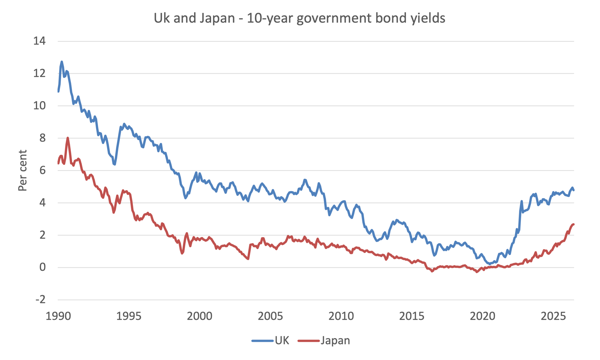
The next graph reveals the 10-year bond yields within the UK and Japan since 1990 (and the actions are consultant of different nations) over this era.
The latest improve in yields is related to one main change – the rise of inflationary pressures following the availability constraints arising from COVID after which later the inflationary pressures arising from the 2 wars (Ukraine and Iran).
The correlation between the bond yields and the fiscal place is poor.
However the correlation with inflationary pressures is excessive.
Additional, Haldane cited the work of British economist David Aikman who he used as an authority for the declare that “Yields are additionally changing into extra delicate to information about deteriorating deficits”.
The proof on that query is just not clear reduce as Haldane suggests.
Slightly, the proof strongly means that absolutely the dimension of fiscal deficits is just not a driving issue within the bond yield dynamics.
The extra influential elements are financial progress expectations, inflationary pressures, and the idea of the ‘safe-haven’.
The so-called ‘safe-haven’ impact refers to the truth that when there’s international turmoil and progress forecasts fall, the big international buyers rapidly transfer funds into authorities bonds as a result of they don’t have any credit score danger (for currency-issuing governments).
The shift drives yields down as a result of the elevated demand drives costs up.
The alternative occurs when there’s a shift in sentiment.
At current, funding funds are shifting out of presidency bonds into AI-type debt merchandise, which is a serious motive that bond yields are rising.
And take into consideration Japan – with the very best progress debt-to-GDP ratio and considerably elevated fiscal deficits for close to three many years – but bond yields didn’t transfer till inflation entered the image.
Equally after the GFC, most currency-issuing governments ran a lot bigger fiscal deficits than traditionally have been the norm with no substantial uptick in bond yields – the demand for the debt was robust all through.
Lastly, there are distinct monetary market dynamics concerned that don’t have anything to do with the fiscal positions.
The position of the ‘sellers’ in bond markets is vital – they’re the “choose group of market-making monetary corporations” (SUERF Coverage Transient No 1173 Could 2025 – Seller constraints and authorities bond markets: A transatlantic perspective).
The sellers are:
… sometimes affiliated with giant banking organizations. These so-called major sellers take part straight within the major marketplace for Treasuries, the place the US authorities auctions new debt issuance, after which resell the Treasuries to buyers within the secondary markets.
These market-makers exist in each nation.
In addition they “act as intermediaries between sellers and patrons within the secondary market” and work together with the central financial institution when it comes to the open market operations (the central financial institution shopping for and promoting authorities debt to handle liquidity).
Regulative adjustments to this intermediation capability have been carefully associated to the motion in bond yields.
The dialogue is just too technical for this viewers and I would write a separate weblog submit about it in an try and make the dialogue accessible.
Put merely, when new monetary laws (for instance, the Basel III Supplementary Leverage Ratio (SLR) guidelines) impinge on the authorized stability sheet house that sellers have to soak up promoting strain within the bond market, the central financial institution has to step in.
Within the interim, bond yields rise as a result of the sellers require greater compensation to justify taking up extra debt.
A examine by the Federal Reserve Financial institution of Boston – Proof That Stress-free Sellers’ Threat Constraints Can Make the Treasury Market Extra Liquid (printed March 4, 2025) – demonstrated this level past doubt that altering laws governing the monetary markets alters bond yields with none shift within the fiscal place.
The SLR primarily requires the tier-1 banks to carry a minimal layer of capital in opposition to their leverage positions and doesn’t distinguish between high quality of the asset.
So the SLR = Tier 1 Capital as a proportion of Whole Leverage Publicity.
Tier 1 capital is the financial institution’s core fairness capital and disclosed reserves – that’s, the buffers in case of losses.
Whole Leverage Publicity is all on-balance-sheet belongings (reminiscent of loans and money) plus off-balance-sheet objects (reminiscent of derivatives and repo-style transactions).
Each greenback of Leverage Publicity is counted equally, whatever the high quality of the asset.
So a risk-free Treasury bond has to have the identical quantity of capital backing it as does a dangerous company bond held by the financial institution.
This acts as a disincentive for the banks to carry Treasury bonds and so the SLR acts as a penalty on low-risk, market-making actions by the sellers within the bond market.
Throughout the early COVID-19 years, the Federal Reserve exempted Treasury bonds from the SLR requirement to release house within the sellers’ stability sheets.
So inside 24 hours, US Treasury bonds not consumed regulatory capital backing and within the first week, banks elevated their Treasury positions by round 10 per cent.
See additionally this paper from the Financial institution of Worldwide Settlements – Seller capability and US Treasury market performance (October 26, 2023).
New regulative adjustments within the US, for instance, are working to push up bond yields.
The US SEC – Treasury Clearing Implementation – guidelines, which have been introduced in December 2023 and are available in operation by December 31, 2026 after which additional shifts by June 30, 2027, principally make transactions regarding bonds safer however have had the influence of elevating prices for the first sellers.
The consequence has been that the elevated prices are being handed on by the sellers demanding excessive bond yields to clear new auctions.
None of that is associated to the fiscal place of the US authorities.
And on this theme, when Trump introduced widespread tariffs in April 2025, the US bond market grew to become very risky because the ‘sellers’ reached the boundaries of the capability to behave as intermediation brokers.
This was additionally nothing to do with the fiscal place of the US authorities.
Conclusion
I perceive that every one this element is just not appropriate for an 1000-word Op Ed, which simply implies that an writer mustn’t make daring claims and drop in a easy reference as whether it is an authority for the daring declare, with out not less than noting the contestability of the argument and offering the nuances.
However the proof doesn’t help Haldane’s central declare that “Keynesianism, if not lifeless, is doubtlessly defunct, besides when squarely centered on public funding.”
I believe the proof suggests fairly the other.
That’s sufficient for as we speak!
(c) Copyright 2026 William Mitchell. All Rights Reserved.