




Geoeconomic danger—the danger that corporations incur valuation losses when international locations deploy financial, commerce, or monetary leverage for geopolitical goals—has develop into a first-order concern for buyers. On this put up, primarily based on our current Workers Report, we doc that home U.S. shares expose buyers to substantial geoeconomic danger by means of corporations’ world supply-chain relationships, affecting buyers’ returns and portfolio allocation. We additionally discover that buyers are compensated for bearing geoeconomic danger by means of greater danger premia.
Export Controls as Geoeconomic Shocks
Traders don’t have to personal overseas shares to be uncovered to geoeconomic danger. Home shares can embed overseas exposures when U.S. corporations promote to abroad clients or depend on world provide chains. These hyperlinks imply {that a} overseas coverage shock can cut back the worth of U.S.-listed corporations and transmit geoeconomic danger to home portfolios. These world hyperlinks can assist buyers diversify their portfolios when shocks are country- or –market-specific, however they provide much less safety when coverage shocks have an effect on the identical worldwide relationships throughout many U.S. corporations. Geoeconomic shocks are due to this fact tough to diversify away as a result of they’ll have an effect on a number of home shares by means of a standard overseas publicity.
We research this danger by means of the imposition of U.S. export controls by the Bureau of Trade and Safety. This company of the Division of Commerce can prohibit U.S. corporations from promoting sure applied sciences to particular overseas entities deemed to be a danger to U.S. nationwide safety. Since 2014, these restrictions have been leveraged continuously within the U.S.-China technological rivalry, particularly in industries corresponding to semiconductors, telecommunications, synthetic intelligence, and superior computing. We interpret the addition of a overseas agency to the export management listing as a manifestation of geoeconomic danger for its U.S. suppliers.
This setting lets us hint geoeconomic danger from focused Chinese language corporations to U.S. buyers. We hand-collect Chinese language entities added to U.S. export-control lists and use FactSet Revere supply-chain information to determine the U.S. suppliers linked to those straight focused Chinese language clients. We then match these affected U.S. suppliers to the holdings of U.S. home fairness mutual funds from the CRSP Mutual Fund Database, masking greater than 5,000 funds from 2010 to 2023. We deal with mutual funds as a result of they’re main buyers in U.S. fairness markets: long-term mutual funds held round a fifth of U.S. company fairness in 2025. As well as, because of their month-to-month portfolio holdings, we observe which funds owned U.S. suppliers to newly focused Chinese language corporations when export controls are introduced, and to trace how managers rebalance their portfolios afterward.
Geoeconomic Danger in Home Portfolios
Regardless of their ostensible focus, home fairness funds have vital publicity to the U.S.-China geoeconomic competitors. On common, 20.3 % of fund property are invested in U.S. corporations with a minimum of one Chinese language buyer. The chart beneath reveals that this publicity is very excessive for funding types tied to progress and expertise. For instance, science and expertise funds make investments 43.3 % of their portfolios in home corporations which might be linked to Chinese language clients. Inside these China-connected portfolios, U.S. suppliers to Chinese language clients newly focused by export controls account for 8.4 % of property.
Home Funds Differ Broadly in Their Publicity to the U.S.-China Competitors
Progress Funds
China publicity (proportion of fund property)
Science & Expertise Funds
China publicity (proportion of fund property)
Industrial Funds
China publicity (proportion of fund property)
Mid/Small – Cap Funds
China publicity (proportion of fund property)
Sources: CRSP Mutual Fund Database; FactSet Revere.
Be aware: This chart reveals the share of U.S. home fairness mutual fund portfolios which might be invested in U.S. corporations with Chinese language clients, by funding type.
Though export controls straight goal Chinese language corporations, additionally they cut back the worth of these corporations’ U.S. suppliers. The chart beneath reveals that, in our information, U.S. suppliers expertise a cumulative irregular inventory return of −3.6 % proper after the announcement that export controls goal a number of of their Chinese language clients, with a lot of the decline occurring throughout the first 5 buying and selling days.
Shares of U.S. Suppliers Fall when Their Chinese language Clients Are Added to the Export Management Listing
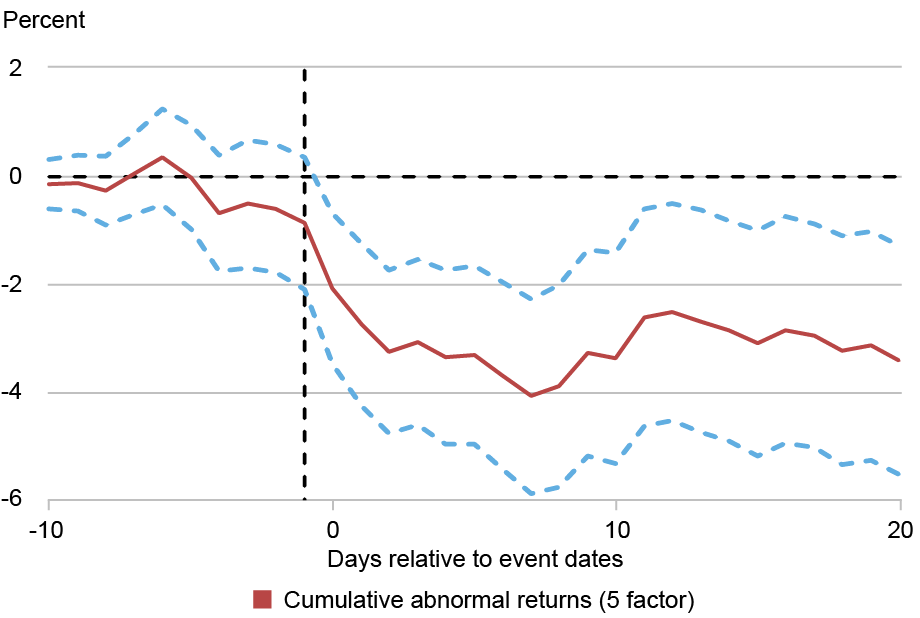
Notes: The chart reveals cumulative irregular returns for shares issued by U.S. corporations that provide straight focused Chinese language clients across the announcement that these clients are added to a U.S. export-control listing. The chart relies on the Fama-French five-factor mannequin.
These value actions lengthen to the mutual funds holding these shares. We measure a fund’s publicity to new export controls because the share of its portfolio invested in affected U.S. suppliers in that month. We then evaluate funds with greater and decrease publicity to export controls inside the identical funding type and month, whereas controlling for fund traits. Funds holding shares of affected U.S. suppliers expertise greater volatility and decrease (uncooked and factor-adjusted) returns following the imposition of export controls. Conditional on an export management occasion, a one normal deviation enhance in publicity (2.5 %) is related to a 22-basis-point decline in month-to-month returns.
Mutual Funds Reply by Rebalancing Away from Geoeconomic Danger
Lively managers cut back holdings of affected U.S. suppliers and in addition promote different China-linked U.S. corporations not affected by the present announcement. The promoting of affected U.S. suppliers, nonetheless seen three months after the export controls, means that managers don’t usually deal with the worth decline as a purely non permanent idiosyncratic shock. This broader promoting means that buyers be taught that geoeconomic danger could also be embedded in complicated supply-chain hyperlinks that weren’t totally priced or understood earlier than the shock. In sum, export controls may function a wake-up name, prompting buyers to be taught extra a couple of portfolio’s oblique publicity to China and to the potential of future restrictions.
This portfolio rebalancing is pushed solely by lively funds, in line with passive funds merely monitoring benchmark indices. For a one normal deviation enhance in publicity, passive funds expertise a 31-basis-point decline in month-to-month returns, in contrast with 22 foundation factors for lively funds. Within the following month, passive funds additionally expertise outflows equal to about 0.35 % of property, whereas the outflows from lively funds are statistically insignificant.
Lively managers due to this fact seem to partially insulate fund efficiency from geoeconomic shocks, however this insulation comes with greater risk-taking. Particularly, uncovered lively funds subsequently maintain extra concentrated portfolios and tilt towards “lottery-like” shares, suggesting that some managers reply to efficiency shortfalls by taking over extra danger to restrict future outflows.
Specialist managers and higher-fee funds expertise smaller efficiency declines after export management shocks, whereas conventional market-timing and stock-picking abilities don’t predict higher outcomes. In sum, the administration of geoeconomic danger may require the flexibility to map potential coverage shocks onto corporations’ positions in world worth chains.
Is Geoeconomic Danger Priced In?
In line with the portfolio proof, buyers appear to require compensation for bearing geoeconomic danger. We kind shares primarily based on prior publicity to export controls and evaluate future returns of high-exposure and low-exposure corporations. A protracted-short portfolio that buys corporations beforehand uncovered to export controls and shorts unexposed corporations earns about 1 % per 30 days in irregular returns after adjusting for traditional danger elements. In different phrases, the market seems to deal with geoeconomic publicity not as a one-time information occasion, however as a priced danger for which buyers demand compensation.
Summing Up
As financial coverage turns into extra intently tied to nationwide safety, corporations’ supply-chain hyperlinks can develop into a channel by means of which geoeconomic shocks have an effect on buyers’ portfolios. For buyers, the related query is due to this fact not solely the place a inventory is listed, however the place the agency earns revenues and the way uncovered these relationships are to geopolitical coverage shocks. Diversification throughout home shares might not totally mitigate this danger when many corporations share comparable world exposures. On this atmosphere, understanding the worldwide linkages of portfolio corporations turns into more and more necessary for understanding portfolio danger.

Matteo Crosignani is a monetary analysis advisor within the Federal Reserve Financial institution of New York’s Analysis and Statistics Group.
Lina Han is an assistant professor of finance on the College of Massachusetts Amherst.
Marco Macchiavelli is an assistant professor of finance on the College of Massachusetts Amherst.
This put up has been revealed concurrently, with minor modifications, on VoxEU.org.
Methods to cite this put up:
Matteo Crosignani, Lina Han, and Marco Macchiavelli, “Navigating Geoeconomic Danger within the U.S. Inventory Market,” Federal Reserve Financial institution of New York Liberty Avenue Economics, October 1, 2026, https://doi.org/10.59576/lse.20261001
BibTeX: View |
Disclaimer
The views expressed on this put up are these of the creator(s) and don’t essentially replicate the place of the Federal Reserve Financial institution of New York or the Federal Reserve System. Any errors or omissions are the accountability of the creator(s).