



LIC has launched a brand new single premium conventional life insurance coverage plan. LIC Dhan Vriddhi (Plan no. 869).
Let’s discover out in regards to the plan intimately.
LIC Dhan Vriddhi (Plan 869): Vital Options
- Single premium plan: You pay the premium simply as soon as.
- Non-linked, non-participating: This implies you already know upfront what’s going to get and when. You possibly can calculate the XIRR from the product upfront.
- Coverage Time period: 10, 15, and 18 years
- Minimal Entry Age: 8 years (10-year coverage time period), 3 years (15-year coverage time period), 90 days (18-year coverage time period)
- 2 choices (variants) based mostly on Sum Assured.
- Choice 1: Life Cowl = 1.25 X Single Premium
- Choice 2: Life Cowl = 10 X Single Premium
- Most Entry Age: Can vary from 32 to 60 years relying on coverage time period and variant (possibility 1 or 2) chosen.
- Mortgage Facility obtainable
Have you learnt there’s a fast and easy strategy to perceive what sort of insurance coverage product you’re shopping for? Taking part, non-participating, or a ULIP. And the way these merchandise differ. Learn this put up to search out out.
Single Premium plans have a novel downside
The maturity proceeds from a life insurance coverage plan are exempt from revenue tax provided that the life cowl is no less than 10 occasions the annual premium or the one premium.
Truthful sufficient. What’s the subject?
Let’s say you pay a single premium of Rs 5 lacs below LIC Dhan Vriddhi. I selected Rs 5 lacs as a result of, from this monetary 12 months, if the combination premium for conventional insurance policies purchased after March 31, 2023 exceeds Rs 5 lacs, the maturity proceeds received’t be exempt from tax. That is over and above 10X premium rule.
By the way in which, all these restrictions are just for survival/maturity advantages. Demise profit is all the time exempt from revenue tax.
Coming again, you have got 2 choices.
- Choice 1: Sum Assured of Rs 1.25 X Single Premium: Sum Assured of Rs 6.25 lacs. The maturity proceeds received’t be exempt from tax.
- Choice 2: Sum Assured of Rs 10 X Single Premium: Sum Assured of Rs 50 lacs. The maturity proceeds can be exempt from tax (offered you don’t breach Rs 5 lacs in mixture rule).
Why would anybody select a decrease Sum Assured and let maturity proceeds turn out to be taxable?
Nicely, not so easy.
Whereas the upper life cowl (Choice 2) ensures that the maturity profit is tax-free, it additionally takes a toll on the returns.
Why?
As a result of a larger portion of your premium/funding should go in direction of offering you life cowl. Conventional merchandise are opaque, and you may’t determine how your cash is getting used to supply you life cowl. Nonetheless, these mortality prices are inbuilt into your product returns. Within the case of LIC Dhan Vriddhi, that is effected by way of decrease assured Additions for Choice 2. We’ll take a look at this facet later within the put up.
Every part else being the identical,
Choice 1 will provide higher pre-tax return, however the maturity proceeds can be taxable. Low Life cowl (Rs 6.25 lacs)
Choice 2 will provide inferior pre-tax return, however the maturity proceeds can be exempt from tax. Excessive life cowl (Rs 50 lacs)
Now, when you should spend money on LIC Dhan Vriddhi, you will need to contemplate the above elements and determine accordingly.
As an illustration, when you suppose you can be in 0% or very low-income tax bracket once you obtain payout (and haven’t any want for a big life cowl), then chances are you’ll be OK with Choice 1 (1.25 X Single Premium). Since you earn higher pre-tax returns (than Choice 2), and also you received’t should pay a lot tax in any case.
The great half is that you’ll know upfront how a lot you’re going to get and when. The one uncertainty is about your tax bracket once you obtain these funds. If in case you have a agency thought, then you may determine simply.
LIC Dhan Vriddhi (Plan 869): Demise Profit
Demise Profit = Sum Assured on Demise + Accrued Assured Additions
Sum Assured on Demise = 1.25 X Single Premium (Choice 1) OR 10 X Single Premium (Choice 2)
We will see how Assured Additions are calculated within the subsequent part.
LIC Dhan Vriddhi (Plan 869): Maturity Profit
Maturity profit is payable when you survive the coverage time period.
Maturity profit = Fundamental Sum Assured + Accrued Assured Additions
Copying the tabulation from LIC Dhan Vriddhi coverage wordings.

As you may see, Assured Additions are decrease for Choice 2. Alongside anticipated strains. That is to include the influence of Larger mortality price in case of Choice 2.
LIC Dhan Vriddhi (Plan 869): What are the returns like?
Let’s perceive this with the assistance of an illustration.
I checked the premium calculator on LIC web site and selected the “On-line” Buy because the medium. You’re speculated to enter the “Fundamental Sum Assured” and never the Single Premium (that you simply need to make investments) as a part of the calculation move.
Observe that “Fundamental Sum Assured” is totally different from Sum Assured on Demise.
I selected the Fundamental Sum Assured of Rs 5 lacs.
Entry age: 35 years (Male)
Choice 1
Coverage Time period: 15 years (I selected the longer tenure)
The next numbers had been mechanically calculated.
Single Premium = Rs 430,000 (excl. GST) (Don’t know the way this was calculated)
Sum Assured on Demise = Rs 5,37,500 (that is 1.25X Single Premium)
Single Premium = Rs 4,49,350 (incl. 4.5% GST)
What would be the maturity quantity?
Assured addition per 12 months = (Fundamental Sum Assured of Rs 5 lacs/1,000) X 70 = Rs 35,000
Assured additions accrued for 18 years of coverage time period = Rs 35,000 X 15 = Rs 5.25 lacs
Maturity Profit = Fundamental Sum Assured + Accrued Assured Additions
= Rs 5 lacs + Rs 5.25 lacs = Rs 10.25 lacs
You make investments Rs 4.49 lacs and get Rs 10.25 lacs after 15 years.
That’s an annual return of 5.65% p.a.
Observe that is pre-tax return. These maturity proceeds can be taxable (after adjusting in your funding).
Choice 2
Coverage Time period: 15 years
Fundamental Sum Assured = Rs. 5 lacs
Single Premium = Rs 4,21,075 (excl. GST) (Don’t know the way this was calculated)
Sum Assured on Demise = Rs 42.1 lacs (that is 10 X Single Premium)
Single Premium = Rs 4,40,023 (incl. 4.5% GST)
Assured addition per 12 months = (Fundamental Sum Assured of Rs 5 lacs/1,000) X 35 = Rs 17,500
Assured additions accrued for 18 years of coverage time period = Rs 17,500 X 15 = Rs 2.62 lacs
Maturity Profit = Fundamental Sum Assured + Accrued Assured Additions
= Rs 5 lacs + Rs 2.62 lacs = Rs 7.62 lacs
You make investments Rs 4.40 lacs and get Rs 7.62 lacs after 15 years.
That’s an annual return of 3.73% p.a.
Despite the fact that the returns are exempt from tax, 3.73% p.a. is a really low fee of return for a 15-year maturity product.
Observe that the returns may even rely in your age. I calculate returns for two entry ages (25 and 35) for Fundamental Sum Assured of Rs. 5 lacs.
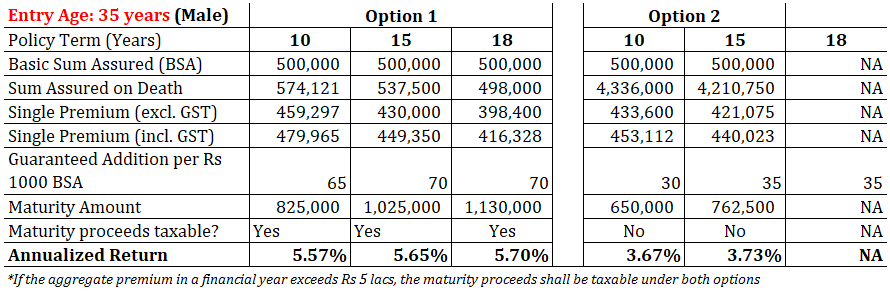

As you may see, the returns are greater for decrease age.
What do you have to do?
I belief your judgement.
Totally different traders have totally different expectations from an funding product. Some need security and return assure. Some need liquidity whereas others are eager on good returns.
With LIC, I wouldn’t fear about my cash not coming again. Furthermore, since LIC Dhan Vriddhi is a non-participating plan, you additionally know upfront what you’re shopping for. What you’re going to get and when. You possibly can calculate CAGR/IRR. Zero confusion.
On the identical time, you will need to contemplate the speed of return and the taxation of maturity proceeds.
Are returns of three.5%-6% p.a. enticing sufficient for a product with a protracted maturity of 10 to 18 years ? Not in my view.
As well as, there are ordinary flexibility problems with conventional plans. For those who should exit for some cause earlier than coverage maturity, there’s a heavy exit price too.
Do you intend to spend money on LIC Dhan Vriddhi? Let me know within the feedback part.
Disclaimer: Registration granted by SEBI, membership of BASL, and certification from NISM under no circumstances assure efficiency of the middleman or present any assurance of returns to traders. Funding in securities market is topic to market dangers. Learn all of the associated paperwork rigorously earlier than investing.
Observe: This put up is for schooling goal alone and is NOT funding recommendation. This isn’t a suggestion to take a position or NOT spend money on any product. The merchandise quoted are for illustration solely and usually are not recommendatory. In a product evaluate, my try is merely to clarify the product construction and spotlight execs and cons. My views could also be biased, and I’ll select to not give attention to elements that you simply contemplate necessary. Therefore, you will need to not base your funding selections based mostly on my writings. There isn’t a one-size-fits-all resolution in investments. What could also be a superb funding for sure traders might NOT be good for others. And vice versa. Due to this fact, learn and perceive the product phrases and circumstances and contemplate your threat profile, necessities, and suitability earlier than investing in any funding product.