


Within the West, notably the English-speaking world, neoliberalism appeared to simply exchange the collectivist values of the total employment period that adopted the Second World Conflict. It constructed a world the place individualism was prioritised over society, regardless that it claimed that society (all of us) could be higher off by pursuing our personal grasping pursuits. All of the collective equipment of the total employment period – welfare state, democratic establishments, social solidarity – have been attacked by the phalanx of assume tanks, media firms that sprung up within the Nineteen Seventies to propagate the ideology. These machines performed on our pure suspicion of politicians to mount a serious reconfiguration of the state below the pretence that by way of privatisation outsourcing, and the promotion of unfettered ‘markets’ we’d all prosper. It was a fraud – a deliberate deception and the query is whether or not the ideological onslaught has develop into so entrenched in our price constructions that will probably be exhausting to maneuver past. In the present day, I wish to convey a few of the analysis I’m doing tracing the best way the neoliberal ideology has interacted with the normal cultural values of Japan. Japan is a curious combine or hybrid of Western and Jap values and one would possibly enterprise to say that the latter make it tougher for neoliberal precepts to unfold as deeply as they’ve within the West. That’s what I’m writing about as we speak. That is Half 1 of a two-part sequence on this matter.
Neoliberalism and the West
I just lately learn the 2015 ebook by American educational – Wendy Brown – which analyses “the totally different ways in which democracy is being hollowed out by neoliberal rationality”.
It’s an attention-grabbing ebook and paperwork what she refers to as:
… neoliberalism’s “economization” of political life and of different heretofore noneconomic spheres and actions.
The concept that human exercise and interactions has been ‘economised’, which means that we now consider our existence and interactions within the language and metrics of ‘markets’ and assume that the slender idea that economists promote of effectivity (which actually is nearly furthering personal revenue) and productiveness are extra useful objectives than moral conduct and ethical price, will not be one developed by Wendy Brown though her work is an eloquent articulation of the which means and implications of that development.
I’ve written earlier than in regards to the work, for instance, of – Harry Braverman – see Find out how to escape of the commodification of the whole lot (July 14, 2025).
That weblog put up incorporates an extra studying record on the work I’ve executed up to now on his concepts.
In his 1974 ebook – Labor and Monopoly Capital: The Degradation of Work within the Twentieth Century – which was printed by Month-to-month Assessment Press, Harry Braverman
Braverman superior his “de-skilling” thesis the place capital systematically restructured labour processes to reinforce their management with the intention to extract increased income.
He additionally proposed that commodification was turning into generalised below Capitalism – extending into increasingly more areas of our ‘social’ lives.
Progressively, these ‘labour processes’ (market-values) subsume our entire lives – sport, leisure, studying, household – the lot.
Every thing turns into a capitalist surplus-creating course of.
This course of has intensified below neoliberalism – it seeks to commodify the whole lot.
That’s create labour processes that produce commodities for revenue.
The unfold of the labour course of is without doubt one of the attribute options of the final a number of a long time.
Even these actions which have beforehand been a part of our non-working lives – our lives away from the oppression of labor – are targets for commodification.
The economisation of human life is about that unfold.
The mass consumption that emerged within the Fifties as Western nations turned richer after WW2, was magnified below neoliberalism and the whole lot turned a ‘product’ to be consumed.
The rise of the (now very damaging) social media in our lives is a part of that and represents, in my opinion, one of many main risks to social stability as, within the phrases of Hugh Rimmington (see – My view from the information chair: the worst of the mob is coming for us (October 17, 2026):
We, the individuals” more and more cope with one another not by way of parliaments or church halls however by way of a digital house whose income rely upon us combating one another.
On the identical time, to make sure collective will was damaged, neoliberalism promoted a ‘divide-and-conquer’ technique which framed those that have been much less lucky (in materials phrases) than others as failures who didn’t aspire or didn’t work exhausting sufficient and many others.
We had beforehand seen those that have been left behind as being the merchandise (victims) of structural failures however neoliberalism reframed the phenomena as particular person failure.
By development, those that pursued a dog-eat-dog way of living have been held out because the epitome of success.
Gordon Gekko sorts!
So when governments have been pressured into abandoning the total employment dedication that had delivered prosperity to most individuals and lowered revenue inequality and many others, the ensuing mass unemployment was constructed as a person failure – lazy individuals who wished to bludge of the welfare system – fairly than a failure of the system to supply sufficient jobs for all.
Neoliberalism additionally fostered what we known as in our 2917 ebook – Reclaiming the State: A Progressive Imaginative and prescient of Sovereignty for a Publish-Neoliberal World (Pluto Books, September 2017) – the ‘depoliticisation’ of public decision-making obligations.
The discretion of our elected representatives was subjugated by the promotion of technocratic elites who pushed the market logic.
The ‘independence’ of central banks is a part of that ruse and we at the moment are discovering nations in ridiculous conditions.
In Australia, the overwhelming issue driving the inflationary pressures at current are power costs arising from Trump’s observe within the Center East.
The upper power costs are feeding into different costs, similar to meals by way of different enter prices (fertiliser, transport, processing and many others).
And local weather change is turning into more and more damaging to agriculture.
However the neoliberal ideology, which incorporates the promotion of financial coverage (rate of interest changes) over fiscal coverage, and the concept if inflation rises, rates of interest must rise, regardless of the explanations for the rise in inflation, is locking the depoliticised coverage equipment into an absurd scenario.
It’s turning into more and more apparent to everybody that the RBA can’t affect on the drivers of the present inflationary pressures by way of rate of interest will increase.
But, right here we’re, the RBA officers are berating us and mountaineering charges and suggesting extra hikes are coming.
For what?
It’s past absurd.
It’s no marvel that the political equipment is falling aside in lots of nations and ridiculous Far Proper events are getting platforms and help.
The political class opted to shift their obligations to the technocrats, who ship damaging coverage selections, which largely serve the pursuits of capital and the rich elites, after which anticipate us to vote for them.
Japan and neoliberalism
The expertise in Japan is considerably totally different.
Quick monitor to 2001.
– was a Cupboard Minister within the Prime Minister Junichirō Koizumi authorities from 2001 to 2006.
He held the place of Minister for Financial and Fiscal Coverage, Minister for Monetary Providers, Minister of State for Privatization of Postal Providers, and Minister for Inner Affairs and Communications.
Simply the ministry names provides you a touch of what was occurring on the time in Japan.
He launched the so-called ‘Koizumi-Takenaka Reforms’ which comprised a reasonably complete set of coverage shifts that ran counter to traditional authorities behaviour in Japan.
One of many targets was the zombie banks that have been carrying huge portfolios of non-performing loans, principally a legacy of the asset bubble crash a decade earlier.
The coverage shift generally known as the ‘Monetary Revival Program’ was launched in October 2002 and lowered them from round 8.4 per cent of complete financial institution loans to 1.5 per cent by the top of that regime.
Previous to the Program, banks might cover their NPLs by way of slack auditing.
The Program compelled the banks to acknowledge the losses and recapitalise although an fairness injection.
The Program threatened to nationalise any financial institution which allowed its capital ratio to fall under the regulatory threshold (one financial institution was so nationalised in 2003).
The NPLs could possibly be bought to government-guaranteed Decision and Assortment Company (RCC), which eradicated them from the stability sheet.
This a part of the coverage shift successfully socialised the personal losses and gave the banks clear house to return to profitability.
The state backstopping was actually contested by progressives however with out it and/or widespread nationalisation, the monetary sector couldn’t perform.
Extra worrying was the labour market deregulation, which successfully destroyed job tenure that had underpinning Japan’s ‘lifetime employment’ framework.
The – 2003 Employee Dispatch Legislation Modification –
See this text for a proof – A Complicated Modification to the Employee Dispatching Act – was devastating for employee well-being.
It abolished controls on utilizing momentary ‘dispatched’ employees (that’s, contract employees) within the manufacturing sector.
All factories have been then in a position to make use of momentary, informal or non-regular labour and negotiate wages accordingly.
Companies seized on the legislative shift and started eliminating full-time everlasting employees with less expensive informal employees and profitability elevated consequently.
A elementary shift within the distribution between wages and income was engineered by the coverage shift.
The wage hole widened between the employees who have been now compelled into non-regular work in comparison with those that held conventional common positions.
For instance, the dispatched or non-regular employees are paid round 40 to 50 per cent in comparison with common staff doing the identical work.
Additionally absent for non-regular employees are bonuses, retirement advantages and the like.
There have been different parts of the laws that will increase revenue inequality (for instance, abolishing the seniority system).
The next graph exhibits the proportion on non-regular employees in complete employment in Japan from 1980.
The affect of the 2003 shift is noticeable.
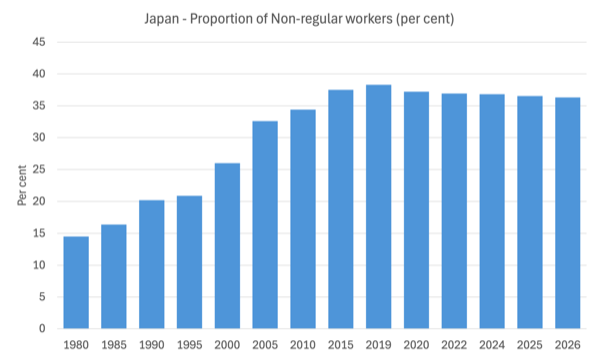
Curiously, throughout COVID it was the non-regular staff that misplaced their jobs (largely).
Then, because the financial system started to recuperate once more, employers have been developing towards the demographic-induced shortages and have been compelled to supply between situations, which stalled the rise within the non-regular employment share.
Companies had no alternative however to restructure their workplaces and supply full-time work.
That development is continuous to as we speak and has been accompanied by the sequential Shunto annual wage rounds that lastly noticed higher nominal wage rises.
cultural values of Japan. Japan is a curious combine or hybrid of Western and Jap values and one would possibly enterprise to say that the latter make it tougher for neoliberal precepts to unfold as deeply as they’ve within the West. That’s what I’m writing about as we speak.
As an apart, after he left workplace, Takenaka took up a place with the Pasona Group, which was Japan’s largest momentary employee company.
The scandal that emerged was that Pasona exploited the Dispatch laws to exchange everlasting workers in authorities companies with non-regular employees, and profiting handsomely within the course of.
The allegations are that Takenaka personally profited from the shift in labour market guidelines that he introducd whereas a accountable Minister.
The dealings over the Tokyo Olympic staffing have been accused of being unethical.
The undermining of employees’ well-being within the labour market was additionally accompanied by the privatisation of Japan Publish, which at the moment was the World’s largest monetary organisation.
The neoliberals claimed that Japan Publish had shifted postal financial savings deposits into wasteful authorities tasks, though the proof for that’s questionable and outdoors to the dialogue as we speak.
The purpose is that JP was a big public enterprise (and the Japanese authorities was simply following the neoliberal insurance policies of governments all all over the world.
Earlier shifts within the Nineteen Eighties had seen the three main public enterprises privatised – Nippon Telegraph and Phone (NTT) in 1985, Japanese Nationwide Railways (JNR) in 1987, Japan Tobacco in 1988.
The Takenaka shift additionally launched fiscal guidelines designed to restrict the capability of the nationwide authorities to spend (chopping public works spending, and many others).
In the direction of the top of his political tenure as minister, additionally tried to privatise the general public broadcasting firm (NHK) however by then his recognition was declining and the Prime Minister stopped that from occurring.
Takenaka’s strategy and the implications of his interventions made him very unpopular.
He had intentionally held himself out to be anti-Keynesian and pro-Austrian faculty of Hayek.
He was towards the usage of large-scale public works packages to assist the financial system mainstain development and employment stability.
He promoted the idea of 自己責任 (Jiko Sekinin) or private accountability, which can be a core idea inside orthodox economics.
He claimed that welfare state help and the availability of public providers eroded the capability of people to take care of themselves.
This strategy was mirroed all all over the world (as mentioned above).
As security nets have been retrenched, increasingly more weak individuals in Japan emerged.
Because of this, whereas Koizumi remained common, Takenaka more and more fell out of favour.
The old-hands within the LDP hated him as a result of his insurance policies disrupted a long time of cosy relationships between the politicians and the firms who funded the occasion machine and their electoral campaigns.
Second, the general public began to understand that the neoliberal dream was a nightmare.
The dismantling of ‘lifetime’ employment hit employees exhausting.
As soon as he left politics, he turned embroiled in scandal.
I’ve already talked about the Pasona scandal.
He’s additionally oblivious to the harm that neoliberalism has wrought in Japan and often seems within the media advocating the full elimination of standard/everlasting employment.
Conclusion
In Half 2, I’ll hint hor all this intersected with the normal social values of Japan.
The results of that intersection was a definite, hybrid mannequin of neoliberalism, which was nonetheless as damaging because the extra pure Western variations.
That’s sufficient for as we speak!
(c) Copyright 2026 William Mitchell. All Rights Reserved.