


In December 2024 I wrote that worldwide shares had been probably the most hated asset class on the planet.
Overseas shares have gone on a pleasant little run since then.
I’m not taking credit score right here. Sentiment has turn out to be more durable than ever to crack. However I’m getting related vibes in the present day in fastened earnings.
Essentially the most hated asset class on the planet proper now must be bonds.
There are numerous clever traders who’ve been making the case in opposition to proudly owning bonds. That case is sensible in numerous methods.
The federal government debt practice appears to be unstoppable. We’ve the biggest deficit outdoors of a monetary disaster in historical past. Inflation stays increased. Nominal GDP progress remains to be excessive.
Rates of interest have been rising. You could possibly make the case that given the present surroundings, they need to be even increased. I’ve talked to quite a lot of fastened earnings portfolio managers who’re shocked bond yields aren’t extra elevated.
From a basic perspective, bond yields appear to have nowhere to go however up. It appears apparent. Simply personal different asset courses apart from bond.
Right here’s the issue — predicting the route of rates of interest, the magnitude of these strikes and their timing may be very laborious.
Shorting bonds would possibly really feel apparent however you could possibly additionally make the case that the simple cash has already been misplaced in fastened earnings.
The Fed raised charges from 0% to greater than 5% within the span of 12 months in 2022 and 2023 and bonds acquired killed:
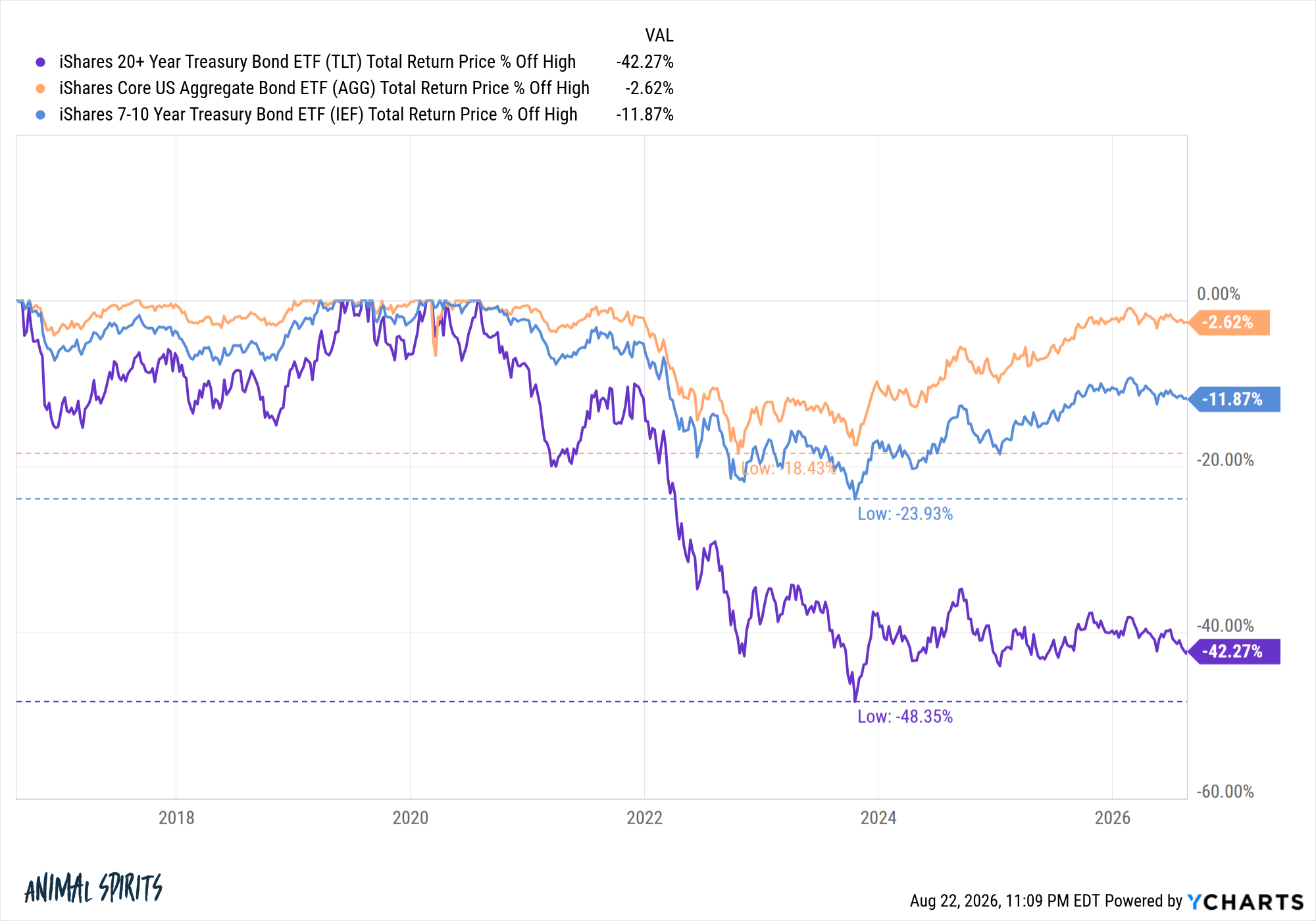
Lengthy bonds acquired annihilated and haven’t even come near regaining these losses. The Agg fell nearly 20%. The ten 12 months Treasury additionally acquired crushed.1
This was the worst bond market crash in historical past. Issues are even worse if we embrace inflation.
There’s an excellent case to be made that the ache in bonds will proceed. Charges would possibly maintain going up. Inflation would possibly maintain going up. Each of this stuff can be unhealthy for bonds within the short-run.
I at all times like to take a look at either side of this stuff to let’s take into consideration the glass-is-half-full case for bonds.
For one factor, bond yields are a lot increased than they’ve been a really very long time. In truth, lengthy bond yields haven’t been this excessive since 2007, proper earlier than the Nice Monetary Disaster.
Buyers within the 2010s and early-2020s would have killed for in the present day’s yields. There’s a much bigger margin for security now.
Though rates of interest have risen this 12 months, these increased yields have helped maintain the losses for bonds in test:
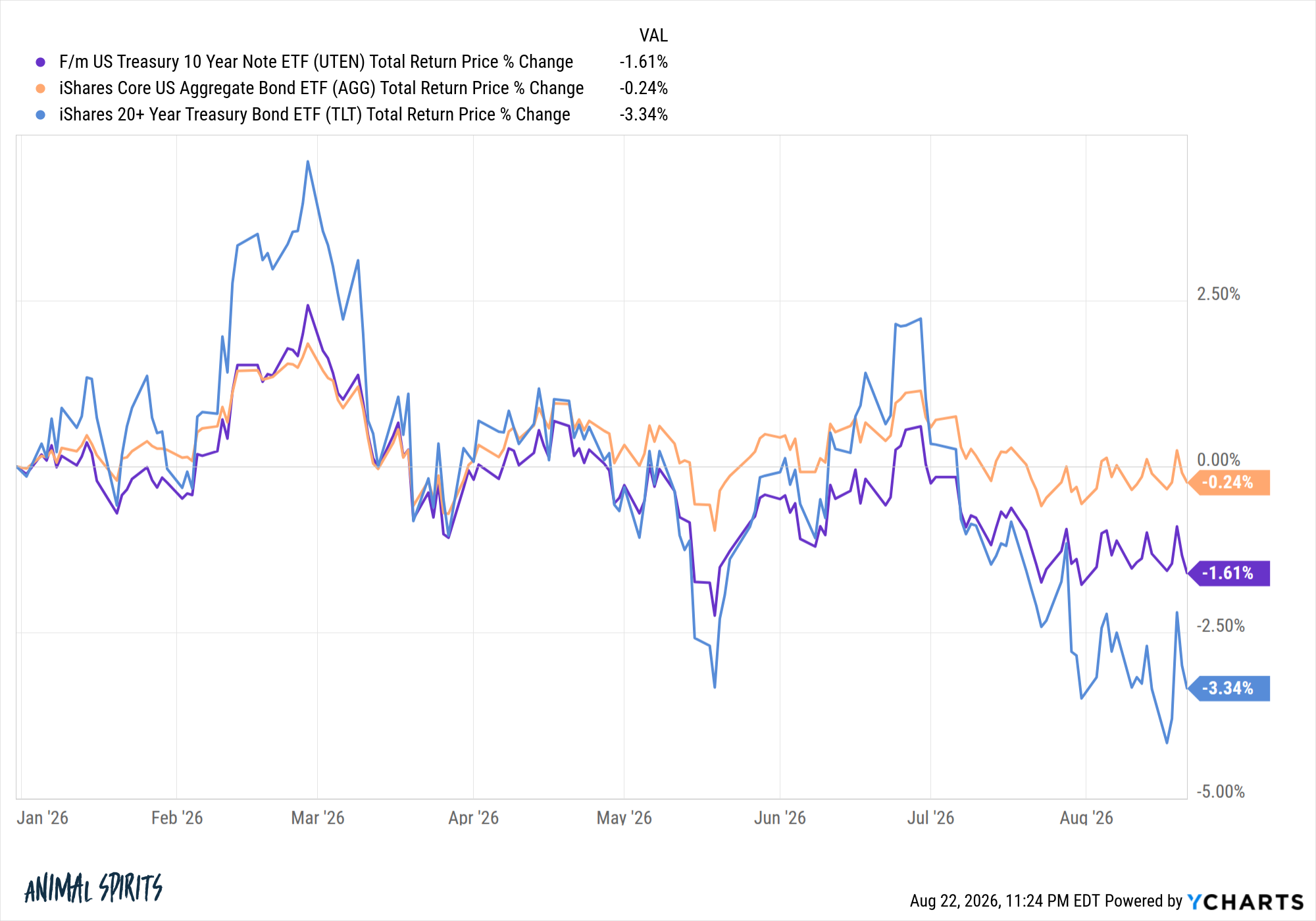
The Agg is actually flat on the 12 months as a result of yields are nearly 5%. Ten 12 months Treasuries are down barely. Even lengthy bonds, whose lengthy length makes them way more delicate to charge modifications, are down simply 3% or so.
If bond yields do proceed to rise, that may trigger some ache within the short-run however these increased yields will imply higher returns sooner or later.
It’s additionally attainable bond yields may keep the place they’re and even fall from present ranges. Loopy, I do know.
Perhaps the struggle ends and inflation drops. Or possibly the financial system slows and that causes charges to fall. We’d also have a recession once more. If this could occur, bonds will see a pleasant increase from the mix of upper beginning charges and falling yields.
As a reminder, bond yields and bond costs are inversely associated. If rates of interest rise (fall), bonds costs fall (rise).
This is the reason each hedge fund supervisor and macro vacationer on the planet desires to brief bonds proper now. They assume charges are going increased and costs are going decrease.
However right here’s the attention-grabbing factor about bonds — the transfer down in costs from a rise in charges is smaller than the transfer up in costs from a lower in charges.
In finance nerd converse, we name this convexity.
My buddies at F/m Investments have a cool device that means that you can see what occurs to bond costs of assorted maturities if charges rise or fall:
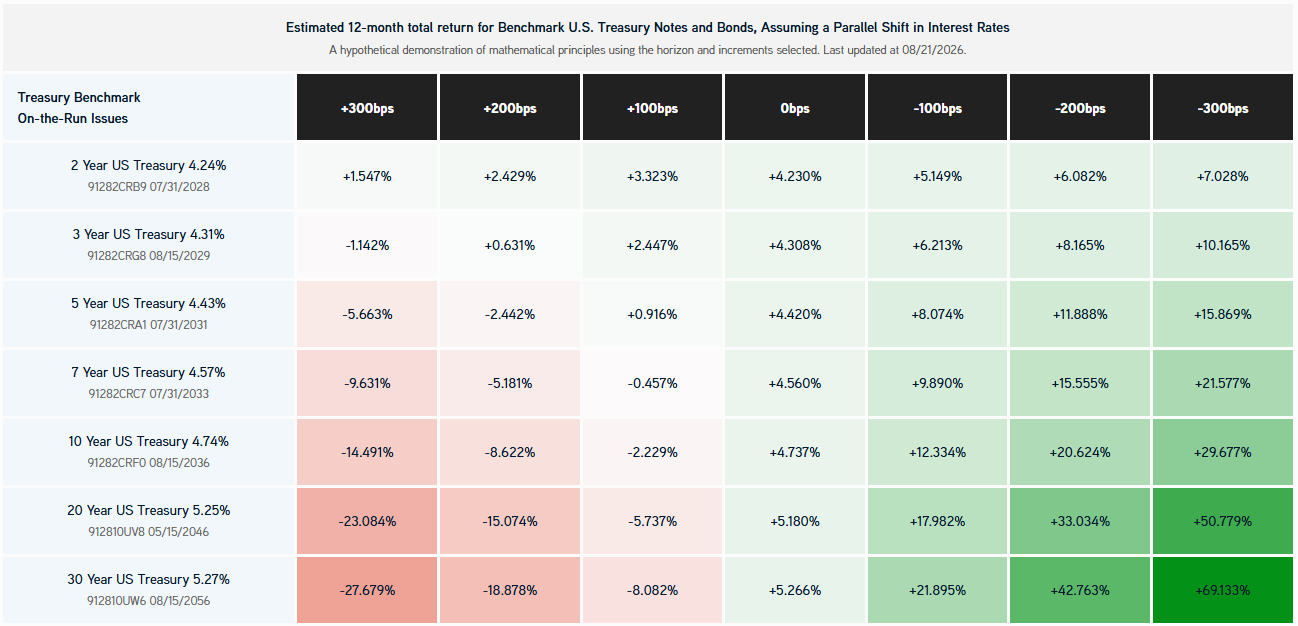
This convexity isn’t set in stone. It could change over time as bond yields change.
However proper now, the achieve you’d obtain from rates of interest falling can be far superior to the loss you’d expertise from rates of interest rising.
For instance, check out the ten 12 months Treasury. If rates of interest had been to drop 1% (100 bps), you could possibly count on the ten 12 months Treasury bond to go up 12% or so within the subsequent 12 months (that’s value appreciation plus the earnings from the bond).
Alternatively, if bond yields had been to rise 1% from present ranges, you could possibly count on to lose just a little greater than 2% over the following 12 months.
The opposite nerd time period for that is an uneven return profile. The achieve you’d obtain for an equal-sized transfer in charges can be bigger than the loss from yields rising.
I perceive why nobody actually cares about bonds proper now. We’re in a bull market. Who cares about 4-6% yields in fastened earnings when the inventory market goes up 20% yearly.
Perhaps all the pundits are proper and we’re in a brand new regime of upper inflation and ever-rising charges that may trigger a world of ache for bond traders.
However traders shall be reminded of the necessity for bonds through the subsequent recession or bear market. Charges will fall. Bonds will rise.
Everybody will want they owned extra prime quality bonds.
There shall be tales written about how silly it was for folks to pile into AI shares when bonds had been yielding a lot.
Are you able to consider 5% yields (or 6% or 7% or no matter) had been simply sitting there and everybody hated bonds!?
Nobody has time for bonds in a bull market.
Bonds will earn their maintain ultimately.
I simply don’t know when it is going to occur.
Additional Studying:
Why Buyers Are Holding Extra Money
1It’s vital to notice these drawdowns embrace the earnings eanrned on the bonds.