


Quite a lot of taxpayers assume that agricultural revenue is totally tax-free in India. Nicely… that’s solely partly true!
Agricultural revenue is certainly exempt from revenue tax beneath Part 10(1) of the Revenue-tax Act, 1961. However right here’s the twist—there are specific conditions the place it could possibly nonetheless sneak in and have an effect on your total tax legal responsibility, despite the fact that it isn’t taxed instantly.
In the event you earn Wage, Enterprise Revenue, or Skilled Revenue alongside Agricultural Revenue, there’s an essential idea you must find out about: the Partial Integration Rule. That is precisely what decides whether or not—and the way—your agricultural revenue quietly influences the tax you pay in your different revenue.
On this article, we’ll break down:
- Is agricultural revenue at all times tax-free?
- When does the Partial Integration Rule kick in?
- How is revenue tax truly calculated in such circumstances?
- A easy calculation instance to make it click on
- Regularly requested questions
Is Agricultural Revenue Taxable?
Usually, no—agricultural revenue isn’t taxed by itself, however that doesn’t imply it’s fully off the radar both.
Agricultural revenue is exempt from revenue tax beneath Part 10(1) of the Revenue-tax Act. Nevertheless, “exempt” doesn’t imply “irrelevant.” In sure circumstances, your agricultural revenue nonetheless will get factored in—to not tax it instantly, however to find out the tax charge that applies to your different taxable (non-agricultural) revenue. So whereas the quantity itself stays untaxed, it could possibly quietly push you into a better tax bracket for the revenue you do pay tax on.
When does Partial Integration Rule apply?
The Partial Integration Rule doesn’t apply robotically to everybody—it solely kicks in when each of those situations are met on the similar time:
- Your agricultural revenue exceeds ₹5,000 throughout the monetary 12 months, AND
- Taxable non-agricultural revenue exceeds the relevant Fundamental Exemption Restrict.
If even certainly one of these two situations isn’t happy, the Partial Integration provisions merely don’t apply, and your agricultural revenue has no bearing on the tax charge in your different revenue.
| Situation | Relevant? |
|---|---|
| Agricultural Revenue above ₹5,000 | ✔ Required |
| Different taxable revenue exceeds Fundamental Exemption Restrict | ✔ Required |
| Each situations happy | Partial Integration applies |
The Authorities launched Partial Integration primarily to make sure that taxpayers with substantial agricultural revenue and taxable non-agricultural revenue don’t find yourself paying tax at a decrease slab charge merely as a result of agricultural revenue is exempt.
How is Revenue Tax calculated?
The components behind this would possibly sound technical, nevertheless it’s truly fairly easy when you break it down.
Right here’s the way it works:
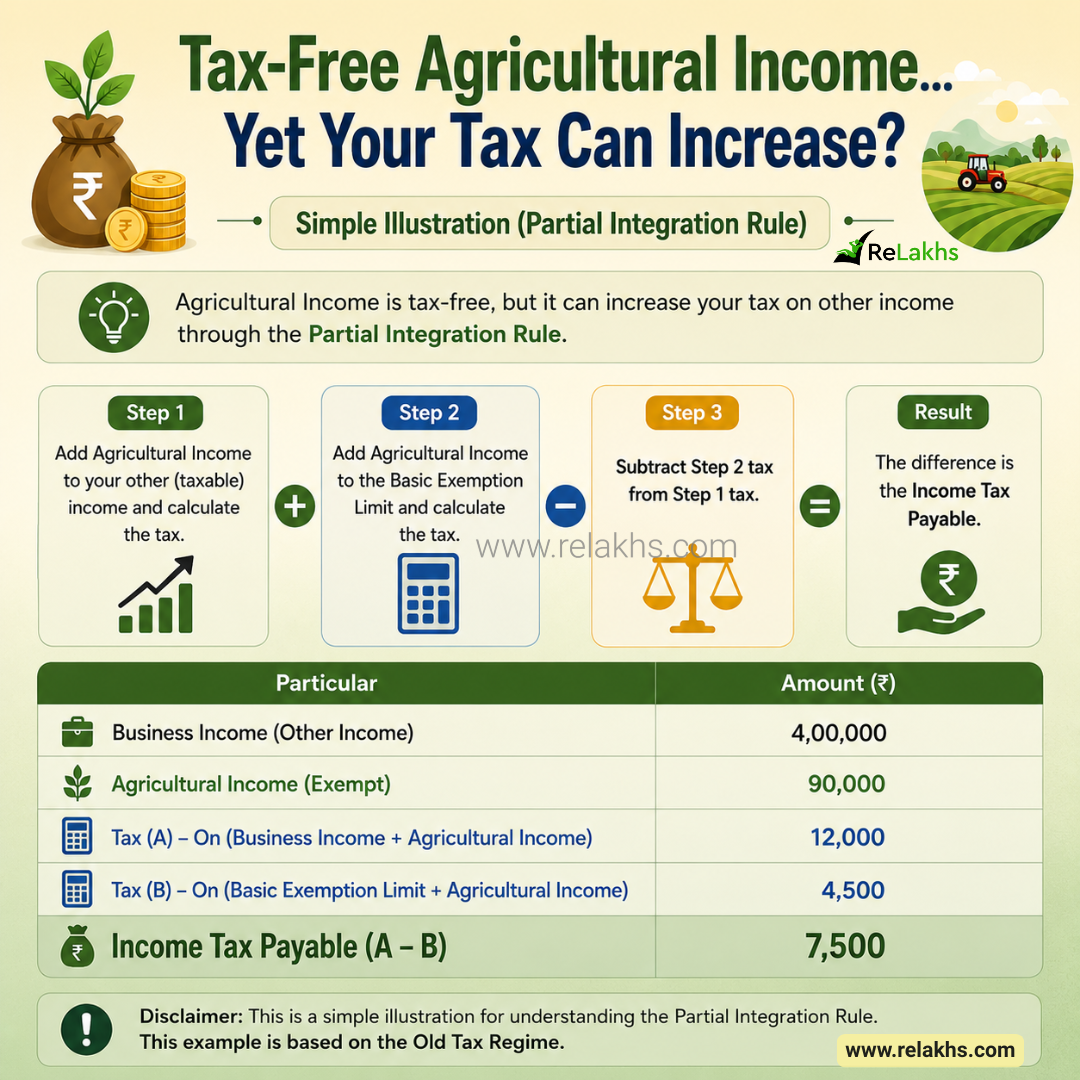
Revenue Tax Payable =
Tax on (Different Revenue + Agricultural Revenue)
Minus
Tax on (Fundamental Exemption Restrict + Agricultural Revenue)
In easy phrases, you first calculate tax as in case your agricultural revenue have been added to your different revenue—this provides you tax at a better slab charge. Then, you calculate tax on simply the exemption restrict plus the agricultural revenue, and subtract that from the primary determine. What you’re left with is the precise tax you owe in your non-agricultural revenue, simply calculated at a charge that displays your complete revenue stage.
Partial Integration Rule – Instance (Previous Tax Regime)
Let’s put the components into motion with a easy instance beneath the Previous Tax Regime.
Assume Mr. Reddy has the next revenue for the 12 months:
- Enterprise Revenue: ₹4,00,000
- Agricultural Revenue: ₹90,000
Since his agricultural revenue is above ₹5,000, and his enterprise revenue already exceeds the Fundamental Exemption Restrict, the Partial Integration Rule kicks in right here.
Step 1: Tax on complete revenue (Enterprise + Agricultural)
We first add each incomes collectively: ₹4,00,000 + ₹90,000 = ₹4,90,000.
- First ₹2,50,000 → Nil
- Remaining ₹2,40,000 @ 5% → ₹12,000
- Tax (A) = ₹12,000
Step 2: Tax on Fundamental Exemption Restrict + Agricultural Revenue
Subsequent, we add the Fundamental Exemption Restrict and agricultural revenue: ₹2,50,000 + ₹90,000 = ₹3,40,000.
- First ₹2,50,000 → Nil
- Remaining ₹90,000 @ 5% → ₹4,500
- Tax (B) = ₹4,500
Step 3: Remaining tax payable
Now we merely subtract Step 2 from Step 1:
₹12,000 − ₹4,500 = ₹7,500
So, Mr. Reddy’s precise tax payable on his enterprise revenue works out to ₹7,500—not the total ₹12,000 you’d get by simply taxing his revenue on the slab charge, and never zero both, since his agricultural revenue nonetheless nudged him into a better charge. Do word, this instance skips Well being & Schooling Cess, surcharge, and the Part 87A rebate to maintain the calculation easy and simple to comply with.
Key Takeaway: Agricultural Revenue continues to stay exempt. Nevertheless, it could possibly not directly improve your revenue tax legal responsibility by influencing the tax slab or tax charge relevant to your taxable revenue. Correct data must be maintained to substantiate Agricultural Revenue if required by the Revenue Tax Division.
Regularly Requested Questions (FAQs)
Is Agricultural Revenue at all times tax-free? – Usually sure. Nevertheless, it might have an effect on the tax calculation in your non-agricultural revenue by means of Partial Integration.
Does Agricultural Revenue develop into taxable if it exceeds ₹5,000? – No. The ₹5,000 restrict is solely one of many situations for making use of Partial Integration.
Can salaried staff even have Agricultural Revenue? – Sure. If a salaried particular person additionally earns agricultural revenue, Partial Integration provisions might apply if the prescribed situations are happy.
Ought to agricultural revenue be reported in your Revenue Tax Return? – Completely! In case your agricultural revenue exceeds ₹5,000, report it beneath Schedule EI (Exempt Revenue) of your Revenue Tax Return. Whereas agricultural revenue is usually tax-exempt, disclosing it accurately is essential and could also be related for tax computation the place the Partial Integration Rule applies.
Conclusion
Agricultural Revenue is among the most misunderstood areas of revenue tax legislation. Whereas it enjoys tax exemption beneath Part 10(1), taxpayers having each agricultural and non-agricultural revenue ought to clearly perceive the Partial Integration provisions to keep away from confusion whereas computing their tax legal responsibility.
Understanding these guidelines may show you how to file your Revenue Tax Return accurately and keep away from pointless notices or errors.
Proceed studying:
(Publish first printed on : 15-July-2026)